



Choosing the right chain hoist capacity begins with knowing the weight you need to lift and the place you will use the hoist. Safety should always be your main concern. If you choose the wrong size, you could have problems like equipment breaking or accidents happening. You might also see unsafe overloading, more breakdowns, or bad performance.
-
Putting too much weight on the hoist can cause bad accidents.
-
Using the wrong hoist often makes work slow and unsafe.
You can stop these problems by using a simple process.
Key Takeaways
-
Always find out the heaviest weight you need to lift before picking a chain hoist. Knowing the right weight keeps everyone safe and stops the hoist from breaking.
-
Pick a hoist that can lift at least 25% more than your load. This extra amount helps if the weight changes by surprise.
-
Think about the shape and balance of what you are lifting. If the load is not even, it can be dangerous. Make sure the weight is spread out the same on all sides.
-
Check how high and how fast you need to lift things. Choose a hoist that can go as high as you need and at the right speed for your job.
-
Always follow the rules from the maker and safety standards. Doing this keeps your team safe and makes sure the hoist works right.
Determine Chain Hoist Capacity

Find Maximum Load Weight
Start by finding the heaviest thing you need to lift. This helps you pick the right chain hoist capacity for your work. There are a few ways to figure out the load weight:
-
Look at the manufacturer’s sheet to see how much your equipment or materials weigh. Remember to add any extra parts or changes.
-
Use a scale or load cell to see the weight right now.
-
Try smart slings with sensors for better and more exact numbers.
-
Check your lifting chains and hooks to make sure they can hold the weight you want to lift.
-
Think about things like water or heat, because these can change how your lifting equipment works.
Tip: Always know the real weight before you pick your chain hoist capacity. If you guess, you could lift things in an unsafe way or break your equipment.
Round Up to Next Capacity
Once you know the heaviest load, do not pick a hoist that matches the weight exactly. You should always choose the next bigger chain hoist capacity. This keeps your lifting job safe and helps everything work well.
|
Reason for Rounding Up |
Explanation |
|---|---|
|
Keeps you safe from lifting too much or if the weight changes |
|
|
Reliability |
Makes sure the hoist can lift the heaviest load safely |
|
Service Life |
Helps the hoist last longer by stopping too much strain |
Picking a bigger chain hoist capacity helps you stop overloads, deal with surprise weight changes, and keep your equipment working for a long time.
Add Safety Margin
You should always add a safety margin to your chain hoist capacity. Many experts say you need at least 25% more than your heaviest load. This extra space keeps your hoist safe from sudden problems and makes lifting safer.
-
Safety margins help your chain hoist last longer.
-
They make sure your equipment works well in all kinds of situations.
-
Margins take in changes in load and speed, so your equipment does not break.
Note: Adding a safety margin is not just a rule. It keeps your team and your equipment safe every time you lift.
If you follow these steps, your chain hoist capacity will fit your needs and keep your workplace safe.
Application and Site Factors
Load Shape & Balance
When you choose a chain hoist, you need to look at the shape and balance of your load. Loads often do not have their weight perfectly centered. If the center of gravity is off, some lifting points may carry more weight than others. This can make lifting unsafe. An irregular load can cause uneven weight distribution. Sometimes, the hoist may lift more than its rated capacity at certain points, which increases the risk of failure. For example, if you lift a large industrial press and a heavy part sits off to one side, the load may tilt and create extra force on the hoist.
To handle unbalanced or odd-shaped loads, you should:
-
Make sure the weight spreads evenly across chains and hooks.
-
Attach the sling above the center of gravity when using one hook.
-
Use rigging tools like slings, shackles, or spreader beams for large or uneven loads.
-
Keep the load stable and level during the lift.
Tip: Always check the center of gravity before lifting. This helps you avoid unsafe situations and keeps your equipment working well.
Lifting Height & Speed
You must think about how high and how fast you need to lift. Lifting height and speed affect which hoist you should pick. Electric chain hoists usually lift faster than manual ones. If you need to move loads quickly or lift them many times in a short period, a faster hoist works better. Long lifts or jobs with many cycles need a hoist with the right speed and height features.
-
Check the lifting height to make sure the hoist can reach where you need.
-
Choose a hoist with a speed that matches your job needs.
-
Electric hoists suit high-speed or frequent lifting tasks.
Power and Suspension Needs
You also need to look at power supply and where you will hang the hoist. Electric chain hoists need a reliable power source. If your site does not have electricity, you may need a manual hoist. Think about where you will suspend the hoist. The support structure must hold the weight safely. Always match the suspension point to the chain hoist capacity and the load you plan to lift.
Note: A strong power supply and safe suspension keep your lifting jobs smooth and safe.
Other Influences on Chain Hoist Capacity
Frequency of Use
You should think about how often you plan to use your hoist. If you use it every day or for many lifts each hour, you need a stronger hoist and a better maintenance plan. Hoists that work in busy places like steel warehouses or scrap yards face heavy loads and frequent use. These jobs need hoists with higher duty cycles and regular servicing.
|
Hoist Type |
Notes on Usage Impact |
|
|---|---|---|
|
Electric Chain Hoists |
At least once a year |
Inspect every six months in high-usage or harsh conditions. |
|
Manual Chain Hoists |
Annually |
Check daily for wear and fix problems right away. |
You can see different duty cycles in industrial work:
-
Class D (Heavy Service): Handles loads near half capacity, 10–20 lifts per hour.
-
Class E (Severe Service): Works at full capacity, more than 20 lifts per hour.
-
Class F (Continuous Severe Service): Runs all the time near full capacity.
If you use your hoist less often, you may not need the highest duty cycle. For busy sites, pick a hoist that matches your work pace.
Portability & Budget
You need to match your hoist to your work site and budget. Lighter hoists are easy to carry and set up. Heavier hoists need more people or machines to move them. The chart below shows how weight changes with capacity:
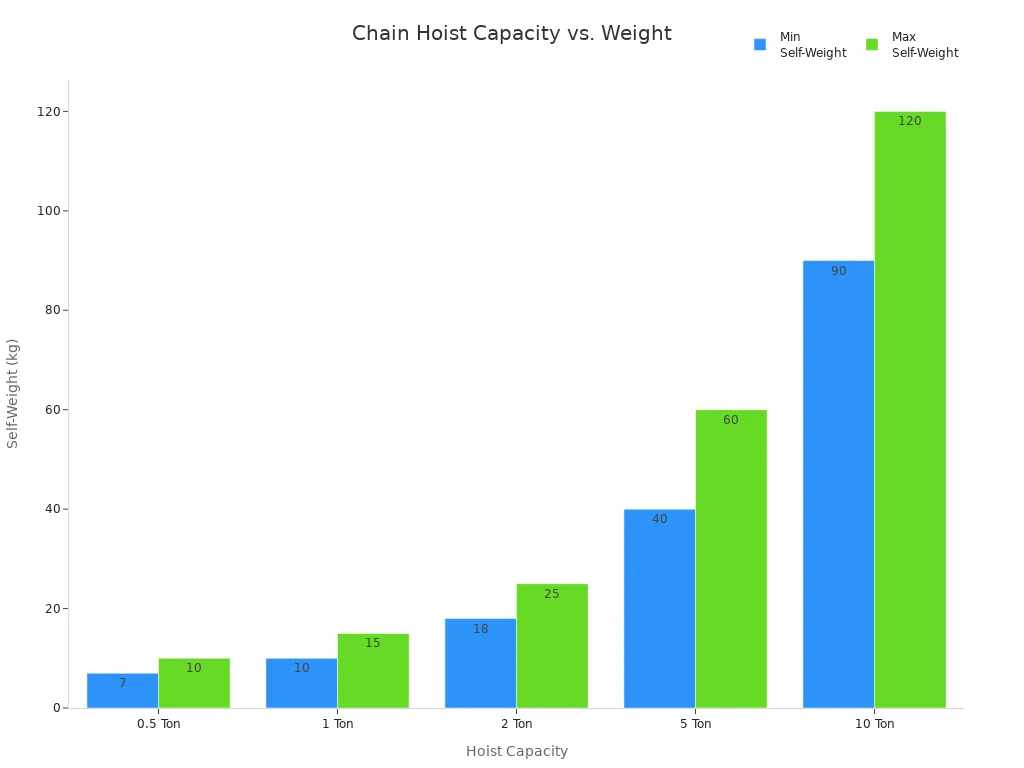
|
Capacity |
Typical Self-Weight |
Portability Profile |
|---|---|---|
|
7 – 10 kg |
One person can carry; good for light jobs. |
|
|
1 Ton |
10 – 15 kg |
One person can manage; fits many uses. |
|
2 Ton |
18 – 25 kg |
One strong person or two people can move. |
|
5 Ton |
40 – 60 kg |
Needs two people; best for semi-permanent setups. |
|
10 Ton |
90 – 120 kg |
Needs machines to move; not portable. |
If you need to move your hoist often, pick a lighter model. If your budget is tight, choose the smallest size that meets your needs. Always check that your choice matches your lifting job.
Environmental Conditions
Your work site can change how your hoist works. You need to protect your hoist from things like:
-
Temperature swings
-
High humidity
-
Chemicals or dust
You can keep your hoist safe by:
-
Using corrosion-resistant materials like galvanized or nickel-plated coatings
-
Lubricating chains often
-
Storing hoists in dry, climate-controlled places
-
Covering hoists in outdoor or harsh areas
-
Picking alloys for cold sites to stop chains from breaking
-
Using sealed bearings and strong covers to block dust and dirt
Tip: Always check your site before you choose a hoist. Protect your equipment so it lasts longer and works safely.
You must consider frequency of use, portability, budget, and environment when you select chain hoist capacity. These factors help you pick the right hoist for your job and keep your team safe.
Safety and Risks
Under- or Over-Capacity Dangers
You must always check the chain hoist’s rated capacity before lifting. If you use a hoist that is too weak, it can break and cause accidents.
Capacity Compliance: Always look at the hoist’s rated capacity before you lift. If you go over this limit, the hoist can break and people can get hurt.
If you use a chain hoist for more weight than it should lift, the motor and parts get too much stress. This can make the hoist break or drop what you are lifting. Never try to lift more than the hoist’s rated capacity. Lifting too much is very dangerous and can ruin your equipment forever.
-
Always check the hoist’s rated capacity before you use it.
-
Lifting too much can break the hoist.
-
This can be very unsafe for everyone.
-
If you use two hoists for a heavy load, the load can move in a risky way.
-
Overloading makes the work area dangerous and can damage the hoist for good.
-
Lower the hoist’s capacity if you lift higher than 12 meters to stop stress and swinging.
Professional lifting jobs should always be safer than the basic rules. Real work can change fast, so you need to be ready for surprises.
Manufacturer Guidelines
You should always follow the instructions from the manufacturer when you pick chain hoist capacity. These rules help you choose the right hoist and keep your team safe.
-
Find out the heaviest thing you will lift.
-
Think about how high and how fast you need to lift.
-
Look at your work area for things that could change how the hoist works.
-
Think about how often you will use the hoist for lifting.
-
Make sure you follow the rules for your industry.
Manufacturers also say you should measure how far you need to lift and check that the hoist is set up right for your job. Always check the total weight your hoist will need to lift.
|
Description |
|
|---|---|
|
ISO |
Makes rules for cranes and hoists all over the world. |
|
ASME |
B30 series (like B30.16) are main safety codes in the U.S. |
|
EN Standards |
Machinery Directive and EN 14492-2 are safety rules in the EU. |
You keep yourself and your team safe when you follow these rules. Safety standards are there to protect people and make sure your equipment works right.
Choosing the right chain hoist starts with knowing your load and workspace. You should follow these expert steps:
|
Step |
Description |
|---|---|
|
1 |
Find the weight you need to lift. |
|
2 |
Check how often you will use the hoist. |
|
3 |
Measure headroom and workspace. |
|
4 |
Work with professionals for best results. |
|
5 |
Make sure your structure supports the hoist. |
Always round up your capacity and read the manufacturer’s guidelines. You keep your team safe when you inspect equipment, match the hoist to your job, and review every factor before buying.
FAQ
What happens if you use a hoist with too low a capacity?
You risk breaking the hoist or dropping the load. This can cause injuries or damage. Always check the rated capacity before lifting anything.
How do you calculate the right chain hoist capacity?
You need to find the heaviest load you will lift. Add a safety margin of at least 25%. Round up to the next available capacity.
Can you use two hoists to lift one heavy load?
You should not use two hoists unless you have special training. Loads can shift and become unsafe. Always use one hoist with enough capacity for the whole load.
Does lifting height affect your hoist choice?
Yes. You must check that the hoist can reach the needed height. Lifting higher can reduce safe working capacity. Always review the hoist’s specifications.