


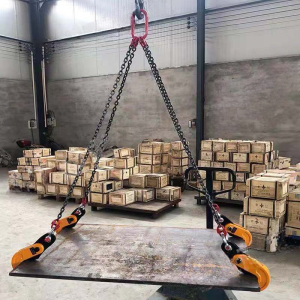
TOYO publishes two different WLL bases, and the two are not interchangeable. For vertical clamps, the CDH and CD series, the published WLL is per clamp. For horizontal clamps, the PDB, PDQ and LC series, the published WLL is per pair. For PDB and PDQ, that per-pair value is defined at a 60 degree lift angle. Check the nameplate and the instruction manual of the exact model before you size a lift.
The basis matters because misreading it changes the rating by a factor of two. Read a per-pair rating as per clamp and you double the assumed capacity of the rig. Read a per-clamp rating as per pair and you order oversized clamps. State the basis in every RFQ.
Key Takeaways
- Vertical TOYO clamps (CDH, CD) publish WLL per clamp. One clamp carries the stated load.
- Horizontal TOYO clamps (PDB, PDQ, LC) publish WLL per pair. Two clamps share the stated load.
- PDB and PDQ define the per-pair WLL at a 60 degree lift angle. Confirm the reference line in the manual.
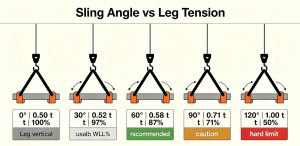
- Sling angle changes leg tension. At a 120 degree included angle, each leg carries the full load.
- PDB has a necessary quantity of four and a top-angle limit of 45 degrees from vertical. PDQ requires at least four clamps plus a lifting beam.
- The nameplate, the manual and a supplier configuration review are the authority. A blog formula is not.
Quick Comparison Table
| Series | Clamp type | WLL basis | Published range | Jaw opening | Weight basis | Key constraint |
| CDH | Vertical | per clamp | 0.8-30 t | 0-16 to 80-220 mm | per clamp | Vertical lifting only, no rotation. Surface below HRC30 / Brinell 300 |
| CD | Vertical, turning | per clamp | 0.8-30 t | match the datasheet row | per clamp | Lifts and turns a plate up to 180 degrees |
| PDB | Horizontal | per pair at 60 degrees | 0.8-16 t | 0-20 to 100-180 mm | per pair | Necessary quantity 4. Top angle max 45 degrees from vertical |
| PDQ | Horizontal | per pair at 60 degrees | 1-20 t | 0-50 to 0-240 mm | per pair | At least 4 clamps, lifting beam required |
| LC | Horizontal | per pair | 1-3 t | 1-13 to 12-35 mm | per pair | Thin plate and structural sections |
Note: these values describe representative models and do not form a general rule. Match the exact row of the specification table for the model you intend to buy, and match the basis in the column header.
How TOYO Publishes WLL by Clamp Type
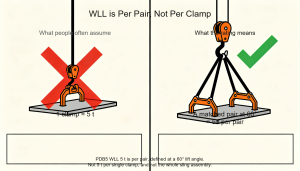
Vertical clamps: CDH and CD, rated per clamp
A vertical clamp grips the plate edge and lifts it upright. One clamp takes the full load, so the published WLL is a per-clamp value. The specification table for both series prints a plain WLL column with no per-pair qualifier, and the weight column is the weight of one clamp.
The CDH is the standard vertical clamp. TOYO-INTL lists 0.8 to 30 t per clamp, with jaw openings from 0-16 mm on the CDH 0.8 to 80-220 mm on the CDH 30. The plate surface has to be below HRC30 / Brinell 300, because clamping depends on friction.
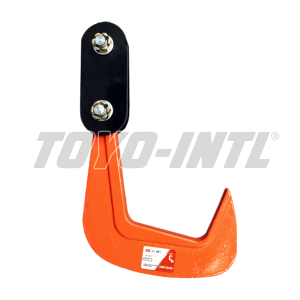
The CD is the universal vertical clamp. It lifts and transports from horizontal, vertical and sideways positions, and it is the only TOYO-INTL clamp published for turning a plate up to 180 degrees with the load retained. TOYO-INTL lists models from CD 0.8 to CD 30. Match the jaw opening to the datasheet row for the model.
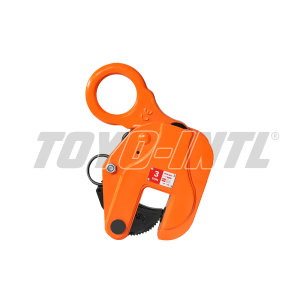
Horizontal clamps: PDB, PDQ and LC, rated per pair
A horizontal clamp carries a plate lying flat. Horizontal lifts use a set of clamps on a spreader arrangement, so TOYO publishes the WLL for a matched pair. The specification tables print the header as WLL per pair, and the weight column is the weight of a pair.
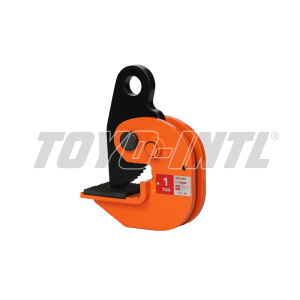
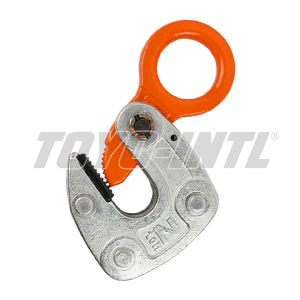
The PDB is the standard horizontal clamp for steel plate and profiled bar. TOYO-INTL lists 800 to 16,000 kg per pair, with jaw openings from 0-20 mm on the PDB 0.8 to 100-180 mm on the PDB 16. The necessary quantity is four and the top angle is limited to 45 degrees from vertical. The PDQ handles single or multiple plates: 1 to 20 t per pair, at least four clamps, and a lifting beam. The LC is the light clamp for thin plate and H, I, T and L sections: 1, 2 and 3 t per pair, published up to 37 RC (345 HB).
What the 60 Degree Lift Angle Means
PDB and PDQ state the WLL as the maximum load the clamps are authorized to support when used in pairs with a lift angle of 60 degrees. TOYO-INTL also publishes a hard limit for the PDB: the top angle must not exceed 45 degrees from vertical.
The two figures use different reference lines. A 60 degree lift angle can be read between the two legs, which is 30 degrees from vertical, or from vertical, which is a 120 degree included angle. Confirm which one the manual for your model means.
The published number is conditional either way. It holds at the stated angle, and the manufacturer data for the exact model governs any wider configuration.
Why the Sling Angle Changes the Load
This is general rigging physics, not a TOYO claim. For a two-leg sling carrying load W, the tension in each leg is:
Leg tension = (W / 2) / cos(theta / 2), where theta is the included angle between the two legs.
| Included angle theta | Leg tension for a 1.0 t load | Usable share of rated WLL |
| 0 degrees | 0.50 t | 100% |
| 60 degrees | 0.58 t | 87% |
| 90 degrees | 0.71 t | 71% |
| 120 degrees | 1.00 t | 50% |
At 120 degrees each leg carries the full 1.0 t load. The plate weight has not changed, but the force in each leg and each clamp has doubled. A wider sling angle always costs capacity.
Measured from vertical instead, the angle factor is 1.00 at 0 degrees, 1.41 at 45 degrees and 2.00 at 60 degrees. An 8,000 kg plate on four legs at 45 degrees from vertical puts 2,820 kg on each leg, overloading a 2,000 kg clamp by 41 percent.
What You Must Not Calculate Yourself
- Do not convert a per-pair WLL into a per-clamp WLL by dividing or multiplying by two.
- Do not apply a 60 degree rating at another angle without manufacturer data for that model.
- Do not copy a side-pull or angle derating percentage from a blog onto a specific clamp model. Derating is model-specific.
- Do not treat the clamp WLL as the whole-assembly WLL. Slings, shackles, the lifting beam and load balance are rated separately.
- Do not extrapolate a family-range figure to a specific configuration. Match the exact model row.
The nameplate, the instruction manual, a supplier configuration review and the governing standard are the only acceptable bases.
Specification Examples
Per-clamp basis, CDH vertical clamp. Weight is one clamp:
| Model | WLL (t per clamp) | Jaw opening (mm) | Weight (kg per clamp) |
| CDH 0.8 | 0.8 | 0-16 | 2.8 |
| CDH 2 | 2 | 0-30 | 6.2 |
| CDH 5 | 5 | 0-50 | 15.8 |
| CDH 10 | 10 | 0-90 | 31.2 |
| CDH 16 | 16 | 60-125 | 80 |
| CDH 30 | 30 | 80-220 | 125 |
Per-pair basis, PDB horizontal clamp. Weight is one pair:
| Model | WLL (t per pair) | Jaw opening (mm) | Weight (kg per pair) |
| PDB 0.8 | 0.8 | 0-20 | 2.65 |
| PDB 2 | 2 | 0-40 | 5.15 |
| PDB 5 | 5 | 0-55 | 6.9 |
| PDB 6B | 6 | 0-130 | 22 |
| PDB 10 | 10 | 0-125 | 32.5 |
| PDB 16 | 16 | 100-180 | 51 |
A PDB 5 listed at 5 t per pair means two clamps together, at the stated conditions, are rated for a 5 tonne load. One clamp is not rated 5 t alone, and the sling assembly is not automatically rated 5 t either.
Decision Tree: Find Your Basis in Six Steps
- Decide the plate attitude. Flat throughout means a horizontal clamp (PDB, PDQ or LC). Upright means a vertical clamp (CDH or CD).
- Decide whether the plate must turn. Turning up to 180 degrees means the CD. No rotation means the CDH for vertical work.
- Set the WLL basis from step 1. Horizontal is per pair. Vertical is per clamp.
- Confirm the sling angle at the actual lift point. For PDB and PDQ the published value holds at a 60 degree lift angle.
- Check the clamp count. The PDB necessary quantity is four. The PDQ needs at least four plus a lifting beam.
- Match the jaw opening to the plate or section thickness, then match the exact model row.
What to Send with a Lifting Clamp Inquiry
- Load weight and dimensions, including plate size and thickness.
- Steel grade and measured hardness at the clamping point.
- Lifting mode: horizontal, vertical, turning, or several plates at once.
- Number of clamps and their arrangement on the load.
- Included sling angle at the actual lift point.
- Jaw-opening range needed versus plate or beam thickness.
- Required lifting height, travel and available headroom.
- Environment: indoor or outdoor, temperature, corrosion, surface condition.
- A sketch showing clamp positions, sling legs and headroom.
FAQ
Is the published WLL per clamp or per pair?
It depends on the clamp type. TOYO vertical clamps, the CDH and CD, are published per clamp. TOYO horizontal clamps, the PDB, PDQ and LC, are published per pair. Check the column header of the specification table and the nameplate of your exact model.
Can I lift twice the per-pair WLL with four clamps?
Not automatically. The PDQ requires at least four clamps in any case, and the per-pair value is still defined at a 60 degree lift angle. Load sharing across four clamps depends on the beam, the sling geometry and the load balance, so the configuration has to be reviewed.
Does the sling angle really change the load on each clamp?
Yes. At a 120 degree included angle each leg carries the full load, which halves the usable share of the rated WLL. This is general rigging physics and is independent of brand.
What does the 60 degree lift angle refer to?
TOYO does not state the reference line in one sentence. It can be read between the two legs, or from vertical. Confirm it in the manual for your model. Either way, a wider angle raises the force on each clamp and needs manufacturer data.
How do I confirm my configuration before ordering?
Send the load, the plate dimensions and hardness, the lifting mode, the clamp count, the sling angle and a lifting sketch. Ask for the manual of the exact model and a written configuration review.
Conclusion and Next Step
TOYO vertical clamps are rated per clamp. TOYO horizontal clamps are rated per pair, and PDB and PDQ define that value at a 60 degree lift angle. Read the nameplate and the manual, match the exact model row, and confirm the sling angle. Do not calculate a rating from a generic blog.
Send TOYO-INTL your load weight, plate thickness and hardness, lifting direction, sling angle and a lifting sketch. TOYO-INTL will confirm the model, the WLL basis, the sling angle limit and the documentation.
Sources and Review
TOYO-INTL sources. The specification tables in this article use the TOYO-INTL published figures:
- TOYO-INTL, Vertical vs Horizontal Plate Lifting Clamps: Which Type Does Your Lift Require? https://www.toyointl.com/news/vertical-vs-horizontal-plate-lifting-clamps
- TOYO-INTL Lifting Clamp and Magnet Lifter. https://www.toyointl.com/product-category/lifting-clamp-magnet-lifter/
Product pages used for PDQ and LC jaw and weight data, and for cross-checking the WLL basis:
- TOYO CDH Vertical Lifting Clamp. https://www.toyo-industry.com/cdh-vertical-lifting-clamp-2/
- TOYO CD Universal Lifting Clamp. https://www.toyo-industry.com/toyo-cd-universal-lifting-clamp
- TOYO PDB Horizontal Lifting Clamp. https://www.toyo-industry.com/pdb-horizontal-lifting-clamp-2/
- TOYO PDQ Single Steel Lifting Clamp. https://www.toyo-industry.com/pdq-single-steel-lifting-clamp-2/
- TOYO LC Horizontal Lifting Clamp. https://www.toyo-industry.com/lc-horizontal-lifting-clamp-2/
General sources:
- ISO 17096:2015, Working Load Limit definition. https://www.iso.org/obp/ui/en/#!iso:std:58103:en
Regional standards noted for reference. They apply only in the relevant jurisdiction. Confirm which standard governs your location and site:
- EN 13155:2020 (European Union, non-fixed load lifting attachments)
- ASME B30.20 (North America, below-the-hook lifting devices)
- AS 4991 (Australia)