



A plate lifting clamp fails for one of three reasons on a real job site: the jaw will not close over the plate, the plate is too thick or too thin for the rated opening, or the clamp cam marks a plate whose surface is harder than the cam can hold. Three numbers settle whether a clamp fits a plate before any lift starts: jaw opening, plate thickness and surface hardness. These three checks apply to every TOYO-INTL plate clamp family, and they are independent of the working load limit (WLL) on the nameplate.
This article lists the three checks in the order a rigger runs them, gives the published jaw-opening ranges for the CDH, CD, PDB, PDQ and LC families, and ends with a checking sequence and an RFQ block. Ordering is by job-site sequence, not by importance; each check must pass on its own.
Three Checks at a Glance
| Check | What it decides | When it fails |
| Jaw opening | Whether the clamp closes over the plate edge | Plate edge wider than max jaw; clamp cannot seat |
| Plate thickness | Whether the plate falls inside the rated thickness band | Plate thinner than min or thicker than max; cam cannot lock |
| Surface hardness | Whether the cam can bite without galling the plate | Plate harder than cam limit; clamp slips or plates the plate |
1. Jaw Opening
Why jaw opening decides fit
Jaw opening is the gap the clamp accepts across the plate edge. Every clamp family publishes a minimum and maximum jaw opening. A plate edge must sit between the two. A plate thinner than the minimum never seats the cam; a plate thicker than the maximum cannot enter the jaw at all. Jaw opening is the first check because it is the only one that can stop the lift before the clamp touches the plate.
What the published data says
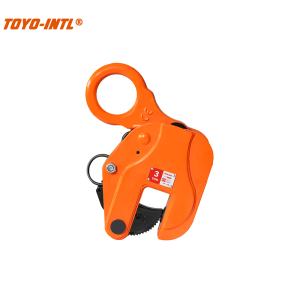
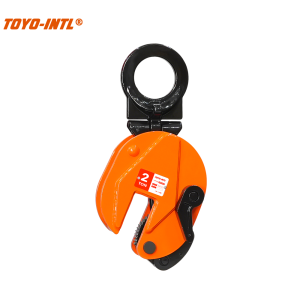
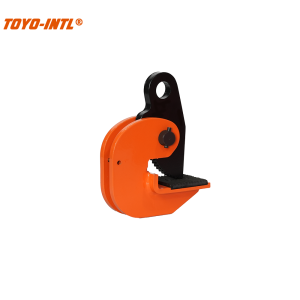
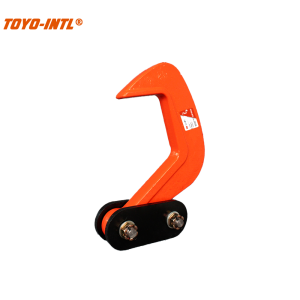
The published jaw-opening ranges for the five TOYO-INTL plate clamp families span 1 mm to 250 mm. Vertical clamps (CDH, CD) rate per clamp; horizontal clamps (PDB, PDQ, LC) rate per pair.
| Family | Orientation | WLL basis | Jaw opening range |
| CDH | Vertical | per clamp | 0–16 to 80–220 mm |
| CD | Vertical, 180° turning | per clamp | 0–15 to 60–220 mm |
| PDB | Horizontal | per pair | 0–20 to 100–180 mm |
| PDQ | Horizontal, multi-plate | per pair | 0–50 to 0–250 mm |
| LC | Horizontal, light plate | per pair | 1–35 mm |
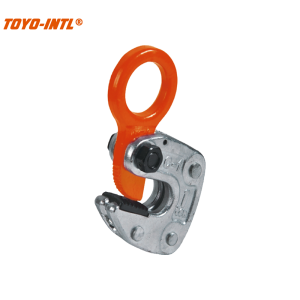
The CDH family covers the widest range, from 0–16 mm on the smallest model up to 80–220 mm on the largest. The LC family is the narrowest, 1–35 mm, because it lifts thin plate only. The CD family mirrors CDH in opening but adds 180° turning; a CD clamp holds the same plate edge as a CDH of the same size and then rotates it. Full family ranges: [CDH lifting clamp], [CD lifting clamp], [PDB lifting clamp], [PDQ lifting clamp], [LC lifting clamp].
What to confirm before ordering
Confirm the plate edge width, not just nominal thickness, before picking a model. A flame-cut edge sits wider than a milled edge at the same plate gauge. Confirm the jaw clears any attached lifting lug, weld bead or mill scale on the edge. Confirm the model whose jaw band straddles the measured edge, not the model whose maximum opening merely exceeds the edge — a 0–50 mm jaw holds a 12 mm plate with reserve; a 0–250 mm jaw on the same plate sits near its stop and seats poorly.
2. Plate Thickness
Why plate thickness sets the cam
Plate thickness is the second dimension a clamp accepts. Every model publishes a thickness band matched to its cam throw. The cam must close against the plate with enough travel to build holding force. A plate below the minimum leaves the cam under-travelled and the clamp unsecured; a plate above the maximum bottoms the cam before it grips. Thickness is checked second because a jaw that closes is useless if the cam cannot load.
What the published data says
The published thickness bands overlap the jaw-opening numbers because the two dimensions describe the same jaw in two directions. For the CDH family, the smallest model holds 0–16 mm and the largest holds 80–220 mm; the same numbers are the plate-thickness band. For the LC family the band is 1–35 mm, sized to H, I, T and L section steel and thin plate. For the PDB family the band runs 0–20 mm on the smallest model up to 100–180 mm on PDB 16.
A plate must sit inside the band of the specific model, not the family. A CDH 5 clamp rated 25–60 mm does not hold a 70 mm plate just because a CDH 30 clamp rated 80–220 mm does. The family range is the envelope; the model band is the fit.
What to confirm before ordering
Confirm the plate gauge at the lifting point, including any corrosion scale or paint film that adds thickness. Confirm whether the plate is stacked: a PDQ clamp lifts single or multiple plates, but the total stack thickness must still sit inside that model’s band. Confirm the band straddles the measured thickness with margin at both ends, not at the maximum alone.
3. Surface Hardness
Why surface hardness protects the plate
Surface hardness is the hardness of the plate face the cam bites. A cam can only hold a plate softer than itself. A plate harder than the cam limit either slips under load or gets metal-plated by the cam, leaving raised burr tracks. Hardness is the last check because it is the only one that damages the plate instead of refusing the lift.
What the published data says
The published hardness limits differ by family. The CDH family specifies plate surface hardness below HRC 30 (Brinell 300). The LC family specifies plate hardness up to 37 RC (345 HB). Both limits are the plate, not the clamp; the clamp cam is harder than the plate by design. A hardened wear plate, a quenched gear or a bearing race will exceed both limits and must be lifted by a magnet, a webbing sling or a purpose-built beam clamp — never by a plate cam.
What to confirm before ordering
Confirm the plate hardness on the mill certificate or the heat-treat record, not by guessing from the grade. A grade S355 plate in the as-rolled condition sits around 150 HB and passes every family; the same grade quenched and tempered can exceed 300 HB and fail the CDH limit. Confirm whether the lifting point has been surface-hardened by induction, carburising or weld overlay. Confirm the clamp family matches the plate condition before the plate matches the clamp.
How to Use the Three Checks Together
The three checks run in sequence because each gates the next. Jaw opening decides whether the clamp seats; plate thickness decides whether the cam loads; surface hardness decides whether the plate survives the cam. A clamp that passes the first two checks on a hardened plate still fails the third, and a clamp that passes all three on a soft plate still fails if the WLL is wrong — the three checks are necessary, not sufficient.
The checks also catch the common ordering mistakes. A buyer who reads only the WLL picks a CDH 30 for a 12 mm plate because 30 t exceeds the load; the jaw band 80–220 mm refuses the plate on the first check. A buyer who reads the jaw opening but not the thickness picks an LC clamp for a 40 mm plate; the 1–35 mm band refuses the plate on the second check. A buyer who reads both but not the hardness picks a CDH for a case-hardened gear; the cam slips or scores the plate on the third check.
The three checks are the same for vertical and horizontal clamps because the geometry is the same. A vertical clamp (CDH, CD) bites the plate edge; a horizontal clamp (PDB, PDQ, LC) bites the plate face, but the jaw, the thickness band and the cam limit all apply. The orientation changes the WLL basis — vertical clamps rate per clamp, horizontal clamps rate per pair — but it does not change the three checks.
A Practical Checking Sequence
- Measure the plate edge width at the lifting point, including scale and weld.
- Pick the family by orientation: vertical lift (CDH, CD) or horizontal transfer (PDB, PDQ, LC).
- Match the measured edge to a model whose jaw band straddles it with margin.
- Measure the plate thickness at the same point and confirm it sits inside that model’s band.
- Read the plate hardness off the mill certificate or heat-treat record.
- Confirm the hardness sits below the family limit (CDH: HRC 30 / HB 300; LC: 37 RC / 345 HB).
RFQ Checklist
- Plate grade and condition (as-rolled, quenched, surface-hardened)
- Plate edge width and plate thickness at the lifting point
- Plate surface hardness from the mill certificate, in HB or HRC
- Lift orientation: vertical transfer, 180° turning, or horizontal travel
- Number of clamps per lift and the load each clamp must hold
- Whether the plate is single or stacked at the lift
FAQ
How is jaw opening different from plate thickness for a lifting clamp?
Jaw opening is the gap across the plate edge the clamp accepts; plate thickness is the cam throw the clamp accepts against the plate face. Both are published as a minimum-to-maximum band for every model, and the plate must sit inside both bands of the chosen model.
Can a lifting clamp hold a plate harder than HRC 30?
A CDH clamp holds plate up to HRC 30 (Brinell 300). An LC clamp holds plate up to 37 RC (345 HB). A plate harder than the family limit must be lifted by a permanent magnet lifter, a webbing sling or a purpose-built beam clamp, not a plate cam.
Do vertical and horizontal clamps use the same three checks?
Yes. Jaw opening, plate thickness and surface hardness apply to vertical clamps (CDH, CD) and horizontal clamps (PDB, PDQ, LC) alike. The orientation changes the WLL basis — per clamp for vertical, per pair for horizontal — but not the three checks.
Does the WLL replace the three checks?
No. The WLL is the load limit; the three checks are the fit limits. A clamp whose WLL exceeds the load still refuses a plate outside its jaw band, its thickness band or its hardness limit. The three checks are necessary; the WLL is additional.
How do I read the jaw opening range on a clamp datasheet?
The range is printed as minimum to maximum, for example 25–60 mm. The minimum is the thinnest edge the cam will load; the maximum is the widest edge the jaw will accept. The measured plate edge must sit between the two with margin at both ends.
Conclusion
Jaw opening, plate thickness and surface hardness are the three fit checks that decide whether a plate lifting clamp seats, loads and holds without damage. Jaw opening gates the seat; plate thickness gates the cam; surface hardness gates the plate. Run them in order, on the measured plate, against the published band of the specific model — not the family envelope and not the WLL alone. A clamp that passes all three still needs a WLL above the load and a lift angle inside the rated cone; the three checks are the floor, not the ceiling.
When the three checks pass, quote the model, the orientation, the plate condition and the load per clamp (or per pair) so the supplier confirms the band against the actual plate. The checks are quick; the cost of skipping one is a refused lift or a marked plate.