


An electric hoist runs on four electrical decisions: the supply voltage the motor connects to, the phase the motor needs, the frequency the motor is wound for, and the control voltage the pendant runs on. Voltage sets the line the hoist plugs into; phase sets whether the hoist needs a single-phase or three-phase supply; frequency sets whether the motor runs at 50 Hz or 60 Hz; control voltage sets the safe voltage the operator holds. The four are specified together because a hoist wound for the wrong one runs slow, runs hot or fails the circuit.
This article covers the four in the order a buyer specifies them. The published TOYO-INTL KDB electric chain hoist lists three-phase 220 to 480 V at 50/60 Hz across the 0.5 to 10 t range; that range anchors the article. Where a value is a general industrial convention rather than a published model figure, it is labelled as such and the buyer is directed to the model datasheet.
Key Takeaways
- Voltage is the supply line the hoist motor connects to; the TOYO-INTL KDB lists three-phase 220 to 480 V.
- Phase is single or three; industrial hoists above roughly 1 t run three-phase, lighter mini hoists run single-phase.
- Frequency is 50 or 60 Hz; a motor wound for one runs the wrong speed on the other and overheats under load.
- Control voltage is the safe voltage the pendant carries; the convention is 24, 36 or 42 V, isolated from the motor line.
- The four are specified together on the nameplate; a hoist ordered for the wrong supply fails the circuit or runs derated.
KDB Lifting and Running Motor Power by Capacity
| Configuration | Chain falls | Lifting motor (kW) | Running motor (kW) |
| KDB 1T | 1 | 1.5 | 0.4 |
| KDB 2T | 1 | 3 | 0.4 |
| KDB 3T | 1 | 3 | 0.75 |
| KDB 5T | 2 | 3 | 0.75 |
| KDB 7.5T | 3 | 3 | 0.75 |
| KDB 10T | 4 | 6 (3×2) | 0.75 |
The lifting motor scales with capacity; the running motor stays small because the trolley rolls, not lifts. The KDB 10T uses two 3 kW motors in parallel to reach 6 kW. The control voltage does not scale with the motor power; a 1 t and a 10 t hoist both run a 24 or 42 V pendant.
Voltage: What the Hoist Connects To
Supply voltage is the line voltage the hoist motor connects across. The TOYO-INTL KDB electric chain hoist lists three-phase 220 to 480 V at 50/60 Hz across the 1 to 10 t configurations, with a 0.5 t variant below. The 220 to 480 V band covers the common industrial low-voltage supplies: 220 V and 230 V in regions on the lower range, 380 V and 400 V across most of Europe and Asia, 415 V in regions on the former British standard, 460 V and 480 V in North America. A hoist built for the band connects to any of them without a transformer.
A hoist ordered outside the band needs a transformer or a different motor winding. A 110 V supply, common on North American residential and light-commercial circuits, cannot run a three-phase industrial hoist directly and needs a step-up transformer or a single-phase mini hoist. A 690 V supply, common in some heavy industrial plants, needs a step-down transformer or a 690 V winding. Confirm the supply at the hoist location before the hoist is ordered, not after it arrives.
Phase: Single or Three
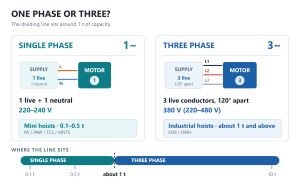
Phase is whether the supply carries one live conductor or three. Single-phase supplies one live and one neutral; three-phase supplies three live conductors 120 degrees apart. Industrial hoists above roughly 1 t run three-phase because three-phase motors start under load, run smoother and carry more power in a smaller frame. Lighter hoists below roughly 1 t can run single-phase because the load is small enough for a single-phase motor.
The TOYO-INTL KDB chain hoist, rated 0.5 to 10 t, runs three-phase throughout. The lighter TOYO-INTL mini hoists — the PA, PAW, TCS and MNTE families rated 0.1 to 0.5 t — run single-phase, because the load sits inside the single-phase motor range. The dividing line is around 1 t: a 1 t and above hoist is three-phase, a 0.5 t and below hoist is single-phase, and a 0.5 to 1 t hoist can be either, depending on the supply available.
Phase is fixed by the motor winding; a single-phase hoist cannot be rewired to three-phase on site. Confirm the supply phase at the hoist location, and order the hoist to match. A three-phase hoist on a single-phase supply will not start under load; a single-phase hoist on a three-phase supply runs one phase only and derates.
Frequency: 50 Hz or 60 Hz
Frequency is the alternations per second of the supply: 50 Hz in most of Europe, Asia, Africa and Australia; 60 Hz in North America, parts of South America and parts of Asia. A motor wound for one frequency runs the wrong speed on the other: a 50 Hz motor on a 60 Hz supply runs 20 percent faster and derates under load; a 60 Hz motor on a 50 Hz supply runs 17 percent slower and overheats under sustained load because the cooling fan turns slower.
The TOYO-INTL KDB lists 50/60 Hz, which means the motor is wound for the dual-frequency range and runs either supply at rated output. A dual-frequency motor is standard on export hoists because the same hoist ships to both frequency regions. A single-frequency motor, wound for 50 Hz only or 60 Hz only, is cheaper but locks the hoist to one region. Confirm whether the hoist is dual-frequency or single-frequency before ordering for a region that differs from the manufacturing region.
Frequency interacts with voltage. The dual-frequency 50/60 Hz motor usually runs across the dual-voltage 220 to 480 V band, because the two are wound together. A single-frequency 50 Hz motor at 380 V is not the same as a dual-frequency 220 to 480 V motor; confirm both on the nameplate.
Control Voltage: The Pendant and the Safety
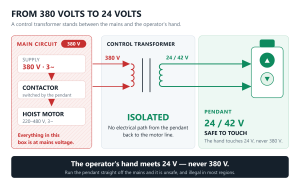
Control voltage is the voltage the pendant and the push-button station carry. The motor runs on the supply voltage — 220 to 480 V three-phase — but the pendant the operator holds runs on a lower, isolated voltage for safety. The convention is 24, 36 or 42 V, isolated from the motor line by a control transformer or a safety extra-low-voltage supply. The operator holds 24 or 42 V, not 480 V, so a fault on the pendant cannot deliver a lethal shock.
The control voltage is not on the main motor spec table; it is on the electrical drawing and the control transformer nameplate. The TOYO-INTL KDB lists the motor voltage and frequency on the main table; the control voltage follows the regional safety convention. A buyer who specifies the region — Europe, North America or Asia — gets the control voltage that meets the regional electrical safety standard.
A hoist ordered without a control transformer runs the pendant on the supply voltage, which is unsafe and illegal in most regions. Confirm the control transformer is included, the secondary voltage is 24, 36 or 42 V, and the pendant is isolated from the motor line. The control voltage is the safety layer; the supply voltage is the power layer.
How the Four Work Together
The four electrical decisions run together because the motor is wound for all four at once. A three-phase 380 V 50 Hz motor runs 380 V across three phases at 50 Hz; the same motor wound for 460 V 60 Hz runs 460 V across three phases at 60 Hz. The control transformer takes the supply voltage and steps it down to 24, 36 or 42 V for the pendant. A hoist ordered with one wrong decision runs derated or fails the circuit.
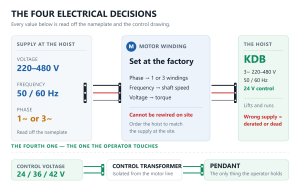
The four are read off the nameplate as a set. The TOYO-INTL KDB nameplate reads three-phase, 220 to 480 V, 50/60 Hz; the control transformer secondary reads 24, 36 or 42 V. A buyer who reads all four matches the hoist to the supply on the first order; a buyer who reads only the voltage misses the phase or the frequency and orders a hoist that runs wrong on site.
The four also decide the motor power and the running power. The KDB 1 t lists a 1.5 kW lifting motor and a 0.4 kW running motor; the KDB 10 t lists a 6 kW lifting motor (two 3 kW) and a 0.75 kW running motor. The motor power scales with the capacity; the control voltage does not. A 1 t hoist and a 10 t hoist both run a 24 or 42 V pendant, because the pendant carries the control current, not the motor current.
RFQ Checklist
- Supply voltage at the hoist location, measured at the terminal
- Supply phase: single or three, confirmed at the panel
- Supply frequency: 50 Hz or 60 Hz, confirmed at the panel
- Control voltage: 24, 36 or 42 V, with a control transformer included
- Motor power for the capacity needed, lifting and running
- Hoist family: three-phase industrial (KDB, DWH) or single-phase mini (PA, TCS)
- Regional electrical safety standard the hoist must meet
FAQ
What voltage does an electric hoist use?
The TOYO-INTL KDB electric chain hoist uses three-phase 220 to 480 V at 50/60 Hz. The lighter mini hoists (PA, TCS) use single-phase 110 to 240 V. Confirm the supply voltage at the hoist location before ordering.
Is a three-phase supply required for an electric hoist?
For hoists above roughly 1 t, yes. The TOYO-INTL KDB chain hoist and DWH wire rope hoist run three-phase throughout. For mini hoists below 0.5 t, single-phase is enough. The dividing line is around 1 t.
Can a 50 Hz hoist run on a 60 Hz supply?
A dual-frequency hoist rated 50/60 Hz runs either supply at rated output. The TOYO-INTL KDB is rated 50/60 Hz. A single-frequency 50 Hz motor on a 60 Hz supply runs 20 percent faster and derates under load; a single-frequency 60 Hz motor on a 50 Hz supply runs slower and overheats.
What is the control voltage on an electric hoist pendant?
The control voltage is the safe voltage the pendant carries, isolated from the motor line. The convention is 24, 36 or 42 V, supplied through a control transformer. The operator holds the control voltage, not the 480 V motor voltage, so a pendant fault cannot deliver a lethal shock.
Does motor power scale with hoist capacity?
Yes. The TOYO-INTL KDB lists a 1.5 kW lifting motor on the 1 t configuration and a 6 kW lifting motor on the 10 t configuration. The control voltage does not scale; a 1 t and a 10 t hoist both run a 24 or 42 V pendant.
Conclusion
Voltage, phase, frequency and control voltage are the four electrical decisions that decide whether an electric hoist runs on a given supply. Voltage sets the line; phase sets single or three; frequency sets 50 or 60 Hz; control voltage sets the safe pendant. The TOYO-INTL KDB lists three-phase 220 to 480 V at 50/60 Hz across the 0.5 to 10 t range, with a control voltage at the regional safety convention. Specify the four together on the order, because a hoist wound for the wrong one runs slow, runs hot or fails the circuit.
To confirm the supply at the hoist location and match the hoist to it, [quote the measured voltage, phase, frequency and the regional safety standard](https://www.toyointl.com/product-category/electric-hoist/) so the supplier winds the motor and the control transformer to match.