



A complete cargo lashing request for quote needs two sides: what the buyer must tell the supplier, and what the buyer must get back. This checklist organizes the required fields by buying scenario. The scenarios are not ranked best-to-worst. Each section lists the information to provide and the documents to request.
Missing fields are the main reason a first quote is unusable. A rating, a webbing width, or a hook type cannot be chosen correctly without the destination market and the lashing method. Use the copyable field list at the end of this article to standardize every inquiry.
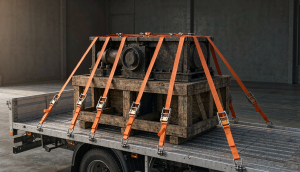
Five Buying Scenarios at a Glance
Start by matching your role to one of the five scenarios. The scenario determines which rating language and which extra fields your RFQ must carry.
Many inquiries mix two scenarios, such as a distributor buying private-label straps for the U.S. market. In that case complete both the private-label fields and the U.S. highway fields so the supplier can quote labeling and ratings together rather than in two separate rounds.
| Buying scenario | Governing rating language | Key extra field |
| 1. U.S. highway transport | WLL (working load limit) | Aggregate WLL vs cargo weight |
| 2. UK/EU highway transport | LC and STF (EN 12195-2) | Lashing angles and friction |
| 3. Industrial / internal fixing | Depends on site standard | Environment and duty cycle |
| 4. Private-label / distributor | Label and certification needs | Marking, packing, samples |
| 5. Replacement parts | Exact existing specification | Model, width, hook type |
1. U.S. Highway Transport Buyer
For U.S. road transport the working rating is the working load limit (WLL). The RFQ must connect the strap WLL to the cargo weight and to FMCSA minimum-count expectations.
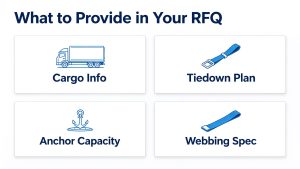
What to provide
- Cargo weight and dimensions, and whether the cargo is blocked or braced.
- Planned number of tiedowns and the lashing method (direct or friction).
- Rated capacity of the vehicle anchor points.
- Required webbing length, width, and end fitting type.
What to request
- The per-strap WLL and the combined WLL of the proposed set.
- A sample product label showing the WLL and manufacturer information.
- Test certificates and U.S.-market documentation for the chosen configuration.
2. UK/EU Highway Transport Buyer
For UK/EU road transport the working rating is lashing capacity (LC) together with standard tension force (STF), governed by EN 12195-2. WLL labels alone do not answer the calculation.
What to provide
- Cargo mass in kilograms and the lashing method (direct diagonal lashing or friction tie-down).
- Expected lashing angles and the friction coefficient between load and deck.
- The number of straps planned and the vehicle anchor rating.
What to request
- The LC and STF values printed on the label for the exact configuration.
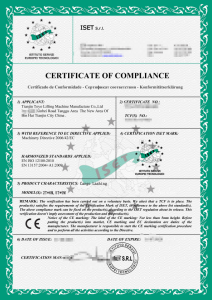
- Confirmation of EN 12195-2 compliance and a declaration of conformity.
- Instructions for use, including the standard hand force and maximum permitted tension.
3. Industrial / Internal Fixed Securing
Internal warehouse, machinery, and engineering installation often tie equipment down repeatedly in a fixed location. Environment and durability matter more than a highway jurisdiction in this scenario.
What to provide
- The equipment being fixed, the fixing frequency, and the operating environment.
- Outdoor exposure, UV, humidity, chemicals, or temperature range.
- Whether sharp edges are present and whether edge protection is needed.
What to request
- Webbing material detail: polyester or polypropylene, and the UV resistance for outdoor use.
- Availability of edge-cutting-resistant tapes and anti-sliding versions.
TOYO-INTL product note: the DL range is described as using ultra-high-tenacity polyester or polypropylene yarns, with the polypropylene series guaranteed for up to 3 years under UV light. Edge-cutting-resistant and anti-sliding versions are offered.
4. Private-Label / Distributor RFQ
Distributors and private-label buyers need consistent labeling, packing, and samples in addition to the strap itself. Some commercial terms are not published on the product page and must be confirmed directly.
What to provide
- Target market and the rating standard that market expects.
- Required label content language, packing, and sample requirements.
- The webbing widths and lengths you intend to stock.
What to request
- Available webbing widths and working lengths for the models you intend to stock.
- Confirmation of labeling and certification that can accompany the product.
To be confirmed: the minimum order quantity (MOQ), private-label branding options, and custom printing are not stated on the TOYO-INTL product page. Do not assume these are available; ask TOYO-INTL directly for the current options and lead times.
5. Replacement-Parts RFQ
Buyers replacing a ratchet, hook, or webbing need the exact existing specification so the new part is compatible. Close matching is safer than a substitute that looks similar.
What to provide
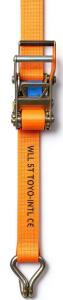
- The existing model code, webbing width, and overall length.
- The end fitting type already in use, such as double J-hooks.
- Whether you need just the ratchet, just the webbing, or a complete assembly.
What to request
- Matching replacement ratchets and end fittings for the chosen webbing width.
- Confirmation that the replacement component is compatible with the existing assembly rating.
Send a clear photo of the existing label together with the model code. The label carries the rating, width, and traceability information that a replacement part must match.
The TOYO-INTL DL Range as a Reference
The following published data is a starting point for building your shortlist. It is product information, not a rating endorsement for your load.
| Model | Published working load (kg) | Working length (m) | Webbing width |
| DL010 | 1,000 | 4-8 | 25 mm (1 in) |
| DL015 | 1,500 | 4-8 | 25 mm (1 in) |
| DL020 | 2,000 | 4-8 | 38 mm / 50 mm |
| DL030 | 3,000 | 4-12 | 38 mm / 50 mm |
| DL040 | 3,000 | 4-12 | 50 mm (2 in) |
| DL050 | 5,000 | 4-12 | 50 mm (2 in) |
| DL080 | 8,000 | 5-12 | 75 mm (3 in) |
| DL100 | 10,000 | 5-12 | 100 mm (4 in) |
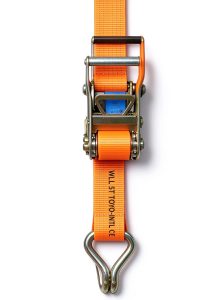
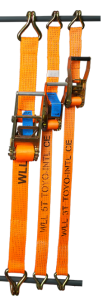
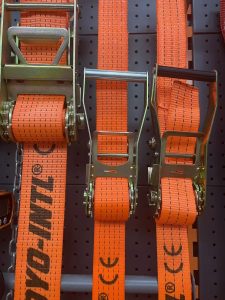
Published features include double J-hooks, automatic retractable ratchets in 50 mm and 25 mm widths, CE certification, a 3-year warranty, and automated stitching intended to reduce human error. The page labels the capacity as working load; confirm whether it maps to WLL, LC, or another standard for your market before quoting.
A Copyable RFQ Field List
Include every field below in your inquiry. Fill in what you know and mark the rest To be confirmed with the supplier.
- Market and standard: destination country and required standard (U.S. FMCSA or UK/EU EN 12195).
- Cargo and lashing method: cargo mass, dimensions, direct or friction lashing, and anchor rating.
- Rating terms: WLL, or LC and STF, for the exact configuration.
- Material, width, and length: polyester or polypropylene, webbing width, and working length.
- Ratchet and end fittings: ratchet type, automatic retract or not, and hook type such as double J-hooks.
- Labeling: required label content, language, and traceability mark.
- Testing and traceability: test certificates and declaration of conformity.
- Packing and samples: packaging, sample units, and private-label needs.
- Documents: manuals, certificates, and any market-specific paperwork.
Frequently Asked Questions
What is the minimum order quantity for cargo lashing?
The minimum order quantity is not published on the TOYO-INTL DL product page. To be confirmed with TOYO-INTL for the specific model and quantity you require.
Do you offer private-label or custom branding?
Private-label branding and custom printing are not stated on the product page. Treat them as To be confirmed, and ask TOYO-INTL directly rather than assuming they are available.
Should I ask for WLL or for LC and STF?
Ask for WLL for U.S. highway work and for LC plus STF for UK/EU work. Telling the supplier your destination market lets them quote the correct rating language.
What documents should I expect with a quote?
Expect a product label sample, test information, and a declaration of conformity or equivalent. Confirm the exact documents needed for your destination market in the RFQ.
Conclusion and Next Step
A usable cargo lashing RFQ depends on the destination market, the lashing method, and the correct rating language. Choose your buying scenario, complete the field list, and send it with your cargo and anchor details.
Email your completed RFQ to TOYO-INTL with the load dimensions, weight, lashing method, destination market, and required documents. TOYO-INTL will confirm the available DL models, ratings, and supporting documentation for your configuration.
Sources & Verification
This article separates industry general guidance from TOYO-INTL product claims. Regulatory statements are jurisdiction-specific and do not replace a qualified load-securement plan. TOYO-INTL product data is taken from the public product pages listed below; any item not published there is marked To be confirmed.
- https://www.toyointl.com/product/toyo-intl-dl-cargo-lashing/
- https://www.toyointl.com/product-category/webbing-sling/
- https://www.ecfr.gov/current/title-49/subtitle-B/chapter-III/subchapter-B/part-393/subpart-I
- https://www.lift-sling.com/wp-content/uploads/2025/03/BS-EN-12195-2-2001-2006-Load-restraint-assemblies-on-road-vehicles-Safety-Web-lashing-made-from-man-made-fibres.pdf