



The United States and the UK/EU use two different rule systems for the same physical load, and the two are not interchangeable. In the U.S., FMCSA sets a minimum strap count by length and weight plus an aggregate working-load-limit floor. In the UK and EU, EN 12195 derives the count from a force calculation based on mass, friction, and lashing angles. The minimum count is a floor, not a target — the goal is enough correctly rated straps arranged so the load cannot shift forward, backward, or sideways in transit.
Why There Is No One-Size-Fits-All Number
No single strap count works because the rules check two things at once: how many straps you use, and whether their combined rating holds the load. A plan can meet the minimum-count rule and still fail the rating rule if the straps are rated too low for the cargo. The reverse is also true — enough total rating spread across too few straps may not stop the load from shifting. A securement plan must satisfy both.
Two Separate Rule Systems by Jurisdiction
Do not mix the two systems. A buyer in the United States should not apply a UK/EU lashing-capacity calculation to a DOT inspection, and a buyer in the UK or EU should not assume a U.S. working load label satisfies EN 12195-2.
| Aspect | United States (FMCSA) | UK / EU (EN 12195-1 / -2) |
| Basis | Minimum strap count by length/weight, plus aggregate WLL | Calculated from mass, friction, angles, and strap count |
| Rating label | Working Load Limit (WLL) | Lashing Capacity (LC) and Standard Tension Force (STF) |
| How count is set | Length and weight table | Force equation result |
| Jurisdiction | 49 CFR Part 393 (U.S.) | EN 12195 series (UK/EU road transport) |
WLL is the maximum load a strap may carry in service (U.S., 49 CFR 393.5). LC is the maximum straight-pull force a web lashing sustains, labeled in daN under EN 12195-2. STF is the residual force left in the strap after the ratchet handle is released; EN 12195-1 sets it at 0.1–0.5 × LC. EN 12195-1 covers the force calculation, and EN 12195-2 covers the strap assemblies and their labels. For full definitions including breaking strength, see our [WLL vs LC vs STF vs Breaking Strength: Ratchet Strap Ratings Explained]; confirm the current text of 49 CFR Part 393 and EN 12195 before an inspection or a purchase.
U.S. Rule (FMCSA, 49 CFR Part 393) – United States Only
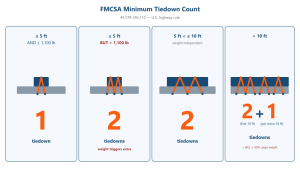
For articles transported on U.S. highways, FMCSA rules set a minimum number of tiedowns based on article length and weight. These counts are a legal floor for commercial motor vehicles in the United States.
- One tiedown: an article 5 ft (1.52 m) or shorter and 1,100 lb (500 kg) or lighter.
- Two tiedowns: an article 5 ft or shorter but heavier than 1,100 lb, or an article longer than 5 ft but not longer than 10 ft.
- Two tiedowns for the first 10 ft, plus one additional tiedown for every extra 10 ft or fraction of 10 ft, for an article longer than 10 ft.
Separately, the combined working load limit of all tiedowns must be at least 50% of the cargo weight. Special cargo such as metal coils, logs, and heavy vehicles has its own dedicated securement rules that can require more straps than the general table.
UK/EU Method (EN 12195-1 and EN 12195-2)
In the UK and EU there is no universal strap-count table. The required number is calculated from the forces the load must resist. EN 12195-2 covers web lashing made from man-made fibres, while EN 12195-1 covers the calculation of securing forces.
- Lashing Capacity (LC) is the maximum straight-pull force a web lashing is designed to sustain.
- Standard Tension Force (STF) is the pre-tensioning force achieved at the ratchet under the standard hand force.
- Direct (diagonal) lashing takes restraining force directly through the straps. Friction tie-down presses the load onto the deck and relies on friction plus STF.
-

F3 direct-vs-friction
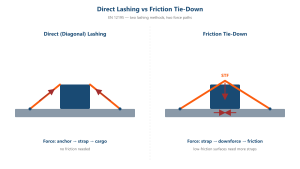
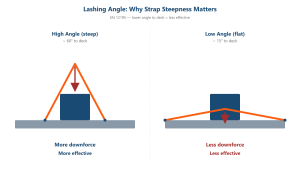
The calculation uses cargo mass, acceleration factors, the friction coefficient between load and deck, the lashing angles, and the number of straps. Low-friction surfaces such as smooth steel on steel need more straps or higher LC. The lower the lashing angle to the deck, the less effective the arrangement becomes.
The Inputs That Change the Number
Before you can decide how many straps you need, collect these inputs. Each one can increase or decrease the required count.
- Cargo mass and overall length.
- Whether the cargo is blocked, braced, or chocked against movement.
- Lashing method: direct lashing, friction tie-down, or a loop around the load.
- Rating of the vehicle anchor points, because the system is limited by its weakest component.
- Sharp edges that require edge protection to prevent webbing cutting.
- Cargo shape and centre of gravity, and any dedicated rules for that cargo type.
Worked Example (Illustration Only)
This example is illustrative and is not an approved load plan. Consider a 3 m long, 800 kg machine on a flatbed in the United States. At roughly 10 ft long and about 1,764 lb, it exceeds the 1,100 lb threshold, so the FMCSA minimum count is two tiedowns.
Next check the rating floor: 50% of 800 kg is 400 kg of aggregate working load limit. Two straps must together provide at least 400 kg WLL. Edge protection is still required if the machine has sharp corners. A qualified person must confirm the actual arrangement before departure.
How TOYO-INTL DL Cargo Lashing Fits In
The following is TOYO-INTL product information, not approval of your complete securement plan. The TOYO-INTL DL Cargo Lashing range publishes working-load values from 1,000 kg to 10,000 kg across webbing widths of 25 mm to 100 mm.
| Model | Published working load (kg) | Working length (m) | Webbing width |
| DL010 | 1,000 | 4-8 | 25 mm (1 in) |
| DL015 | 1,500 | 4-8 | 25 mm (1 in) |
| DL020 | 2,000 | 4-8 | 38 mm (1.5 in) / 50 mm (2 in) |
| DL030 | 3,000 | 4-12 | 38 mm (1.5 in) / 50 mm (2 in) |
| DL040 | 3,000 | 4-12 | 50 mm (2 in) |
| DL050 | 5,000 | 4-12 | 50 mm (2 in) |
| DL080 | 8,000 | 5-12 | 75 mm (3 in) |
| DL100 | 10,000 | 5-12 | 100 mm (4 in) |
The DL range uses ultra-high-tenacity polyester or polypropylene yarns. The polypropylene series is guaranteed for up to 3 years under UV exposure. Edge-cutting-resistant tapes and anti-sliding versions are offered, and automatic retractable ratchets are available in 50 mm and 25 mm widths. Double J-hooks are specified for grip, and the product is CE certified with a 3-year warranty.
Evidence to confirm: the DL product page labels the value as working load, but does not state whether it corresponds to U.S. WLL, EN 12195-2 lashing capacity (LC), or breaking strength. To be confirmed with TOYO-INTL before the value is used in either a U.S. or UK/EU calculation.
Common Mistakes
One common mistake is counting straps while ignoring total working load limit or lashing capacity. Another is treating breaking strength as the working rating, when breaking strength is a test value, not a usable working value.
Buyers also forget to account for friction and lashing angles, run webbing over sharp steel edges without protection, and assume one rating number can serve both the U.S. and UK/EU markets. Each of these can turn a correctly counted load into an unsecured one.
Buyer Information Checklist
Provide the following to a supplier so they can review a suitable strap range:
- Destination country and the governing jurisdiction (U.S., UK/EU, or internal site rules).
- Cargo length, width, height, and weight.
- Whether the load is blocked, braced, or chocked.
- Planned lashing method (direct, friction, or loop lashing).
- Rated capacity of the vehicle anchor points.
- Required rating system (U.S. WLL or UK/EU LC and STF).
- Webbing material preference (polyester or polypropylene) and outdoor/UV exposure.
- Sharp edges requiring edge protection.
- Required certificates, declarations, and labeling language.
Frequently Asked Questions
Do I need two straps or four straps for a 20 ft load?
Under the U.S. FMCSA general rule, a load longer than 10 ft needs two tiedowns for the first 10 ft plus one more for each extra 10 ft or fraction. A 20 ft load therefore needs four tiedowns by count, provided the rating floor is also met. Dedicated rules for specific cargo may require more.
Is breaking strength the rating I should use?
No. Breaking strength is a failure test value. Working load limit (WLL) in the U.S. and lashing capacity (LC) under EN 12195-2 are the working ratings designed for use in securement calculations.
Can I use U.S. WLL numbers for a UK/EU shipment?
Not without confirmation. The U.S. uses WLL, while the UK/EU EN 12195 system uses LC and STF. Confirm the rating system and test standard that applies to your destination market.
Does blocking let me use fewer straps?
Blocking or bracing can reduce the restraining force the straps must provide, but the minimum legal tiedown count and the rating floor still apply. Have a qualified person confirm the effect of blocking on your specific plan.
Conclusion and Next Step
There is no fixed number of ratchet straps that fits every load. Start with the jurisdiction, then the cargo length and weight, the lashing method, and the anchor ratings. Use the U.S. FMCSA count table for U.S. highway work and the EN 12195 force calculation for UK/EU work.
Send TOYO-INTL your load dimensions, weight, vehicle, anchor points, lashing method, and destination market for a product and specification review. This article does not approve a complete securement plan; the qualified person responsible for the load must approve the final arrangement.
Sources & Verification
This article separates industry general guidance from TOYO-INTL product claims. Regulatory statements are jurisdiction-specific and do not replace a qualified load-securement plan. TOYO-INTL product data is taken from the public product pages listed below; any item not published there is marked To be confirmed.
- https://www.toyointl.com/product/toyo-intl-dl-cargo-lashing/
- https://www.toyointl.com/product-category/webbing-sling/
- https://www.ecfr.gov/current/title-49/subtitle-B/chapter-III/subchapter-B/part-393/subpart-I
- https://www.lift-sling.com/wp-content/uploads/2025/03/BS-EN-12195-2-2001-2006-Load-restraint-assemblies-on-road-vehicles-Safety-Web-lashing-made-from-man-made-fibres.pdf