



Remove a ratchet strap from service immediately if the webbing is cut, frayed through load-bearing stitches, melted or glazed by heat, chemically damaged, knotted, or if the WLL label is missing or illegible, or if the ratchet or hooks are cracked, bent, or corroded. U.S. FMCSA rules (49 CFR 393.104) and EU EN 12195-2 both require damaged lashing equipment to be taken out of use.
Scope and Disclaimer
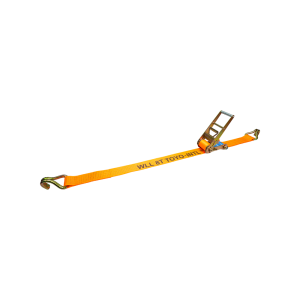
This checklist covers textile webbing ratchet tie-downs (also called cargo lashing straps), including the TOYO-INTL DL Cargo Lashing series. It does not cover chain assemblies, wire rope, steel strapping, or lifting slings used for overhead hoisting. The criteria below summarize U.S. FMCSA and EU EN 12195-2 requirements; they are not a substitute for the manufacturer’s instructions, a qualified safety officer’s judgment, or the carrier’s written securement program. When the manufacturer’s manual is stricter than this checklist, follow the manual.
Why Pre-Use Inspection Matters
A ratchet strap fails gradually. Cuts, UV exposure, heat, and chemical contact reduce webbing strength before any visible break appears. FMCSA 49 CFR 393.104(b) states that all tiedowns must be in proper working order with no damaged or weakened components, including cracks or cuts that reduce the working load limit. An inspector who finds a damaged strap may rate its WLL at zero, which can put the entire load out of service even if the other straps are sound.
TOYO-INTL’s own ratchet tie-down guide advises operators to inspect straps for fraying, tears, or damaged hardware before use and to store straps in a dry, protected area away from direct sunlight. The DL series uses ultra-high-tenacity polyester or polypropylene webbing, high-strength sewing thread, and 45-grade electroplated steel ratchets; each component has its own failure modes.
Step-by-Step Inspection Checklist
1. Label and Traceability
Locate the identification label on the webbing. It must show the working load limit (WLL in the U.S. or LC/STF in the EU), width, length, material, and manufacturer.
- Remove from service if the label is missing, illegible, or has been painted or stained over.
- Remove from service if the label does not match the strap in hand (wrong width, wrong material).
- Record the strap ID or purchase date so retired units can be tracked.
2. Webbing: Cuts, Abrasions, and Snags
Run the full length of webbing through both hands, looking at both sides and the edges.
- Remove from service for any cut that penetrates more than 10 percent of the webbing width or reaches the load-bearing yarns.
- Remove from service for localized abrasion that exposes or breaks load-bearing yarns; general surface fuzzing may be monitored.
- Remove from service for pulled or broken warp threads at the edges.
- Edge protection must be added wherever the strap contacts a sharp cargo edge, per FMCSA 393.104(f)(4).
3. Load-Bearing Stitches
Examine the stitched loops at the hooks and the ratchet end. These stitches carry the full WLL.
- Remove from service if any load-bearing stitch is broken, worn through, or pulled out.
- Remove from service if the stitch pattern is visibly deformed or stretched beyond its original shape.
- TOYO-INTL notes that automated manufacturing is used to minimize stitching defects, but stitched loops must still be checked on every unit.
4. Heat, Friction, and Chemical Damage
Heat and chemical damage weaken fibers invisibly. Look for surface changes rather than tears.
- Remove from service for glazing, glossiness, melted fibers, or hard spots caused by friction or heat.
- Remove from service for chalky, flaking, or brittle webbing that indicates chemical attack (acid or alkali).
- Remove from service if the strap has been exposed to welding spatter, slag, or open flame.
- Polypropylene webbing is damaged by temperatures above roughly 80 degrees C; polyester is sensitive to strong acids. Confirm exposure history before reuse.
5. UV and Weather Degradation
UV exposure gradually weakens polyester and polypropylene. TOYO-INTL guarantees its polypropylene tie-down series for 3 years under UV light, but that warranty does not replace inspection.
- Remove from service for significant fading, chalkiness, or stiffening after prolonged outdoor exposure.
- Store straps out of direct sunlight when not in use.
6. Ratchet Mechanism
Open and close the ratchet several times. It should tension smoothly and lock firmly.
- Remove from service if the ratchet will not lock, slips under tension, or has a broken release latch.
- Remove from service for cracked, bent, or severely corroded ratchet housing.
- Clean dirt and grit from the pawl and spindle; do not use a strap whose mechanism binds.
- TOYO-INTL DL ratchets use 45-grade high-strength steel with electroplated colored-zinc corrosion protection; rust or plating failure on load-bearing parts is a rejection trigger.
7. End Fittings: Hooks and Rings
Check double J-hooks, S-hooks, or flat hooks for deformation, cracks, and wear.
- Remove from service for bent, opened, or cracked hooks.
- Remove from service for hooks whose throat has stretched open beyond original dimensions.
- Remove from service for severe corrosion that pits the metal.
- Replace any hook that does not seat securely on the anchor point.
8. Knots and Twists
FMCSA 393.104(f)(1) explicitly prohibits tiedowns that contain knots.
- Remove from service immediately if the webbing has a knot. A knot can reduce strength by more than half.
- Untwist and flatten the webbing before tensioning; persistent twists should be inspected at the contact points.
9. Post-Incident Inspection
After any hard braking, shift, fall, or accident, inspect every strap involved even if it looks intact.
- Remove from service straps that were overloaded beyond their WLL, even without visible damage.
- Remove from service straps that were burned, cut, or chemically exposed during the incident.
- A competent person should determine whether a strap may return to service after a non-critical event.
Removal-from-Service Summary
| Defect | U.S. FMCSA basis | Action |
| Cuts reaching load-bearing yarns | 393.104(b): no weakened components | Scrap immediately |
| Knot in webbing | 393.104(f)(1): knots prohibited | Scrap immediately |
| Broken load-bearing stitches | 393.104(b): damaged components | Scrap immediately |
| Heat/glazing/melting | EN 12195-2 rejection criteria | Scrap immediately |
| Chemical damage (chalky/brittle) | EN 12195-2; manufacturer instructions | Scrap immediately |
| Missing or illegible WLL label | 393.104(b); WSTDA-T1 marking | Scrap immediately |
| Cracked, bent, or corroded ratchet/hook | 393.104(b): no weakened components | Scrap immediately |
| Localized abrasion, surface fuzzing | Monitor; remove if yarns exposed | Competent person decides |
Storage and Record-Keeping
Store ratchet straps in a clean, dry area away from direct sunlight, exhaust, chemicals, and extreme temperatures. Do not roll multiple straps into a tangled bundle; coil them loosely and tuck the free end. TOYO-INTL’s guide recommends untying knots and avoiding storage against sharp warehouse edges. Keep a simple log that records purchase date, inspection date, condition, and removal date for each strap. EN 12195-2 practice recommends formal inspection by a competent person at least annually for working fleets.
Common Inspection Mistakes
- Looking only at the webbing and forgetting to open and close the ratchet.
- Leaving a strap in service because the label says CE but the webbing is cut.
- Repairing or re-stitching a damaged strap. Repairs must follow the manufacturer’s instructions or applicable standard; in most cases webbing straps are disposable and must be scrapped.
- Using a strap that survived an overload because it still looks intact. Overloaded fibers may be internally damaged.
- Confusing U.S. WLL labels with EU LC/STF labels. They are not interchangeable; confirm the jurisdiction before quoting capacity.
Frequently Asked Questions
How often should ratchet straps be inspected?
Inspect before every use. EN 12195-2 practice also recommends formal inspection by a competent person at least annually for fleet equipment. Condition, not calendar age, determines retirement.
Can a slightly frayed strap still be used?
Surface fuzzing from general wear may be monitored, but any fraying that breaks load-bearing yarns, any cut reaching the stitches, or any localized abrasion on a sharp edge triggers removal from service.
What is the difference between WLL and LC?
WLL (Working Load Limit) is the U.S. term under FMCSA and WSTDA-T1. LC (Lashing Capacity) and STF (Standard Tension Force) are the EU EN 12195-2 terms. They are not interchangeable; use the label matching your destination market.
Can I repair a torn ratchet strap myself?
No. FMCSA 393.104(f)(2) requires repairs to follow the applicable standard or manufacturer’s instructions. In practice, webbing tie-downs are scrapped, not repaired.
Does TOYO-INTL publish model-specific inspection limits?
The DL Cargo Lashing page publishes working loads, widths, lengths, and material descriptions, and notes edge-cut-resistant versions and 3-year UV guarantee on polypropylene. Model-specific rejection thresholds beyond the general criteria above are To be confirmed from the TOYO-INTL technical manual.
Conclusion
Ratchet strap inspection is a pre-use safety step, not an optional cleanup. Cuts, broken stitches, heat or chemical damage, knots, missing labels, and damaged ratchets or hooks all require immediate removal from service under U.S. FMCSA 49 CFR 393.104 and EU EN 12195-2 practice. The TOYO-INTL DL Cargo Lashing series uses polyester or polypropylene webbing, high-strength stitching, and electroplated steel ratchets; each component must be checked on every use.
Download and print the checklist above, attach it to your securement equipment cabinet, and ask TOYO-INTL for the exact inspection and rejection instructions for your DL model.
Sources & Verification
- TOYO-INTL DL Cargo Lashing product page: https://www.toyointl.com/product/toyo-intl-dl-cargo-lashing/ (model table, materials, ratchet construction, features; accessed September 2026)
- TOYO-INTL How to Use a Ratchet Tie Down guide: https://www.toyointl.com/news/how-to-use-a-ratchet-tie-down-a-step-by-step-guide/ (pre-use inspection, storage, and safety tips)
- FMCSA 49 CFR 393.104 Standards for cargo securement devices: https://www.ecfr.gov/current/title-49/part-393/section-393.104 (damaged-device prohibition, no knots, edge protection, WSTDA-T1 webbing reference)
- EN 12195-2 (European Standard for lashing equipment on road vehicles) — rejection criteria for webbing lashings, as reflected in manufacturer operating instructions; buyers should confirm the current edition for their market.