


A well-prepared RFQ (Request for Quotation) gets buyers a usable electric hoist quote on the first try. The exact fields depend on how the hoist will be used. This guide organizes the RFQ fields around five common buying scenarios so buyers can match their application to the right specification set.
The five scenarios below are not ranked from best to worst. Each scenario highlights which RFQ fields matter most and which TOYO-INTL product series publish relevant specification data. Buyers should still confirm the final model and configuration with TOYO-INTL before ordering. Incomplete RFQs usually lead to wrong voltage, wrong lifting height, or a quoted model that does not fit the beam.
Five Buying Scenarios at a Glance
| Scenario | Primary RFQ focus | TOYO-INTL series to review |
| 1. Small workshop / occasional lift | Light capacity, single-phase power, simple control | MNTE, PA, TE portable winch |
| 2. General warehouse / pallet handling | Medium capacity, beam travel, standard three-phase supply | KDB, HHBT |
| 3. Repetitive production line | Duty cycle, starts/hour, dual speed, positioning | TD, TCS mini hoist |
| 4. Long-lift / double-girder project | Lifting height, high capacity, FEM/ISO work group | DWH, SWH, TC, HHBD |
| 5. Dealer stocking for a defined market | Standard SKUs, packaging, MOQ, destination documents | KDB, TD, HHBT (standard models) |
1. Small Workshop / Occasional Lift
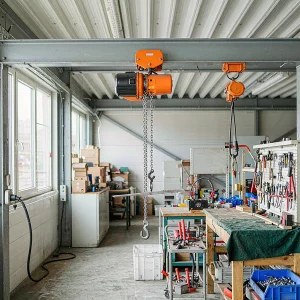
A small workshop or maintenance bay typically lifts light loads a few times per day. The buyer usually has a single-phase wall outlet and limited overhead structure.
Key RFQ fields for this scenario:
- Maximum load weight (kg or t) plus estimated sling or fixture weight.
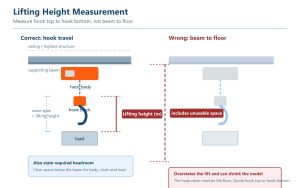
- Required lifting height from hook top to hook bottom.
- Available power supply: voltage, phase, and frequency (e.g., 220 V single-phase 50 Hz).
- Suspension type: hook-mounted fixed or manual trolley.
- Indoor environment: temperature range, dust level, and humidity.
TOYO-INTL series with published data:
- MNTE Electric Chain Hoist: 0.3–0.5 t capacity, 220 V, M4 work class, IP54 protection, published two-speed options of 3/9 m/min (300 kg) and 1.5/4.5 m/min (500 kg). Source: toyointl.com electric hoist category page.
- PA Electric Hoist: 0.1–1.2 t capacity, 220/230 V 50 Hz, 6–12 m lifting height, 5–10 m/min lifting speed, wire-rope type. Source: toyointl.com electric hoist category page.
- TE Portable Electric Winch: 0.1–0.5 t capacity, 5 m/min lifting speed. Source: toyointl.com electric hoist category page.
To be confirmed:
- Exact lifting height available for the selected MNTE or PA configuration.
- Whether a trolley or fixed suspension is required.
- Local plug type and control voltage for the destination market.
2. General Warehouse / Pallet Handling
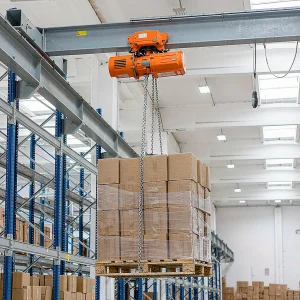
A warehouse or distribution center moves pallets, crates, and packaged goods across a defined travel path. The hoist usually runs on a single-girder beam with a trolley.
Key RFQ fields for this scenario:
- Typical and maximum load weight including any lifting attachment.
- Required lifting height and available headroom below the beam.
- Three-phase supply: voltage (e.g., 220–480 V), frequency (50/60 Hz), and phase.
- Beam type, flange width, and required travel distance along the runway.
- Desired lifting speed and whether a single speed is sufficient.
TOYO-INTL series with published data:
- KDB Electric Chain Hoist: 0.5–10 t capacity, 4 m lifting height, 1.8–6.8 m/min lifting speed, three-phase 220–480 V 50/60 Hz, trolley configuration with published traveling speed. Source: toyointl.com electric hoist category page.
- HHBT Electric Hoist: 0.5–10 t capacity, 3 m lifting height, 2.3–7 m/min lifting speed. Source: toyointl.com electric hoist category page.
To be confirmed:
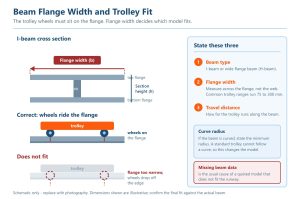
- Beam flange width and runway length for the trolley fit.
- Required lifting height beyond the published 3–4 m standard.
- Control method: pendant station, radio remote, or both.
3. Repetitive Production Line
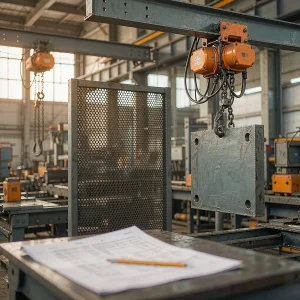
A production or assembly line runs the hoist many times per hour across multi-shift operation. Duty cycle, starting frequency, and positioning speed matter more than maximum capacity.
Key RFQ fields for this scenario:
- Typical load and maximum load per lift.
- Estimated lifts per hour and operating minutes per hour (duty cycle / ED%).
- Required lifting speed and whether a low creep speed is needed for positioning.
- Available voltage, phase, and frequency at the workstation.
- Environment: welding sparks, dust, humidity, or wash-down requirements.
TOYO-INTL series with published data:
- TD Electric Hoist: 0.5–10 t capacity, 4 m lifting height, 2.7–8 m/min lifting speed, M5 work class, IP55 protection, insulation class F, electromagnetic brake, upper and lower double limit switches, 360-degree rotatable forged hook, G80 nickel-plated chain. Source: toyointl.com electric hoist category page and published product description.
- TCS Mini Electric Hoist with Digital Weight Display: 0.17–0.49 t capacity, 21–30 m lifting height, 2.2–22 m/min lifting speed. Source: toyointl.com electric hoist category page.
To be confirmed:
- Exact duty cycle (starts/hour and ED%) for the proposed TD configuration.
- Voltage and control voltage options for the destination market.
- Whether wireless remote control is available for the selected TD row.
4. Long-Lift / Double-Girder Project
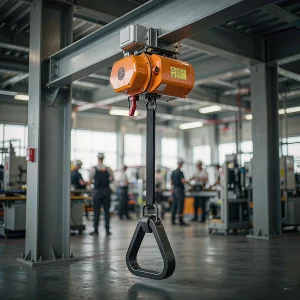
A heavy industrial or infrastructure project needs high capacity, long vertical lift, and a defined FEM/ISO work group. The hoist is typically mounted on a double-girder crane.
Key RFQ fields for this scenario:
- Maximum load weight and any oversized or off-center loads.
- Required lifting height (m) from hook highest to lowest position.
- Required FEM/ISO work group (e.g., 1Am/M4 through 4m/M7).
- Lifting speed and whether paired (coarse/fine) speeds are required.
- Travel speed along the bridge and runway layout.
TOYO-INTL series with published data:
- DWH Double Girder Electric Hoist: 1–16 t capacity, 6–30 m lifting height, paired lifting speeds of 0.66/4 to 1.6/10 m/min, published FEM/ISO work groups from 1Am/M4 to 4m/M7, wire rope at 2160 MPa, Q345 seamless-steel drum, frequency-conversion control box, intelligent safety monitor with brake-wear alarm. Source: toyointl.com electric hoist category page and published product description.
- SWH Double Girder Electric Hoist: 1–16 t capacity, 6–30 m lifting height, 0.66–1.6 / 4–10 m/min paired speed range. Source: toyointl.com electric hoist category page.
- TC Electric Hoist: published lifting height of 20–49 m. Source: toyointl.com electric hoist category page.
- HHBD Electric Hoist: 1–10 t capacity, 3/9 m lifting height, 2.2–8.8 m/min speed. Source: toyointl.com electric hoist category page.
To be confirmed:
- Availability of the exact lift height and work group combination for the required capacity.
- Bridge girder width, trolley rail, and end-carriage compatibility.
- Required certificates and test reports for the destination market.
5. Dealer Stocking for a Defined Market
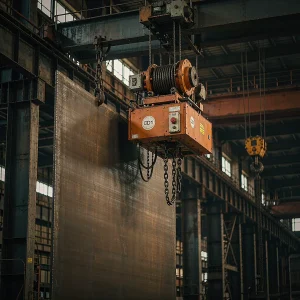
A distributor or dealer stocks standard hoist models for resale in a specific country or region. The RFQ must cover packaging, lead time, MOQ, and required local documentation in addition to specs.
Key RFQ fields for this scenario:
- Target market country and applicable voltage/phase/frequency standard.
- Standard capacities and lifting heights to stock.
- Minimum order quantity (MOQ) per model and per SKU.
- Packaging: export carton dimensions, pallet configuration, and container loading.
- Required documents: CE declaration, test certificate, user manual language, warranty terms.
TOYO-INTL series with published data:
- KDB Electric Chain Hoist: 0.5–10 t, 4 m, three-phase 220–480 V — broad standard range. Source: toyointl.com electric hoist category page.
- TD Electric Hoist: 0.5–10 t, 4 m, M5, IP55 — mid-duty standard model. Source: toyointl.com electric hoist category page.
- HHBT Electric Hoist: 0.5–10 t, 3 m — entry-level chain hoist. Source: toyointl.com electric hoist category page.
To be confirmed:
- MOQ, lead time, and available stock quantities per model.
- Private-label or dealer branding options.
- Local voltage and plug-type customization for the target market.
Consolidated Electric Hoist RFQ Checklist
Copy the following fields into your RFQ and fill in each row:
| RFQ field | What to provide |
| Maximum load | Weight in kg or t, plus any sling/fixture weight |
| Typical load | Weight of the most common lift |
| Lifting height | Vertical travel in m (hook top to bottom) |
| Required headroom | Space available below the beam or support |
| Duty cycle | Lifts/hour, operating minutes/hour, shifts/day |
| Lifting speed | Required m/min, single or dual speed |
| Travel speed | Required m/min if trolley-mounted |
| Power supply | Voltage, phase, frequency (V / ph / Hz) |
| Control voltage | Pendant or remote control voltage |
| Beam / runway | Beam type, flange width, span, curve radius if any |
| Suspension | Fixed hook, manual trolley, or electric trolley |
| Environment | Indoor/outdoor, dust, humidity, temperature, chemicals |
| Destination | Country / region for shipping and certification |
| Documents | CE, test certificate, manual language, warranty |
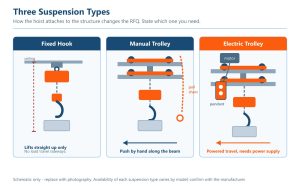
Next Step: Send Your RFQ
Fill in the checklist above and send it to TOYO-INTL. Include a sketch or photo of the installation area if possible. TOYO-INTL will review the application and confirm which model and configuration match the requirements. The more complete the RFQ, the fewer revision rounds are needed before delivery.
Frequently Asked Questions
What is the most important field in an electric hoist RFQ?
Maximum load weight is the starting point. It must include the sling or lifting fixture weight, not just the payload. A quote based on payload alone can undersize the hoist.
Do I need to specify duty cycle?
Yes for repetitive production use. Duty cycle (lifts per hour and operating minutes per hour) determines the required work class (such as M4, M5, or FEM/ISO groups). A hoist sized only by capacity may overheat on a high-cycle line.
Can I use a 220 V single-phase hoist on a three-phase supply?
Not without confirming the motor and control compatibility. Single-phase and three-phase motors are different designs. State the exact available voltage, phase, and frequency in the RFQ. Do not assume adjacent voltage values are interchangeable.
How do I know if my beam fits the hoist trolley?
Provide the beam type (I-beam or wide-flange), flange width, and any curve radius. TOYO-INTL publishes trolley track-width and beam-range data for selected models. The final fit must be confirmed against the actual beam dimensions.
Is the first scenario in this article the cheapest option?
No. The order organizes five common buying scenarios. It is not a price ranking, quality ranking, or recommendation. Each scenario lists different RFQ priorities and different TOYO-INTL product series to review.