



Choose a plate lifting clamp or a permanent magnetic lifter according to the load material, surface, and lifting path. A mechanical clamp grips by jaw pressure and works on plate surfaces regardless of magnetism. A permanent magnet lifter adheres by magnetic attraction and only works on ferromagnetic, flat, clean steel.
Neither tool is the universal best answer. The correct choice depends on the exact load and the published limits of the model.
TOYO-INTL sells both families in one category. Its CDH vertical plate lifting clamp publishes working load limits from 0.8 to 30 tonnes, while its PML permanent magnet lifter publishes rated lifting weights from 100 to 5,000 kg. These figures are model-specific examples. They do not mean that every clamp or every magnet lifter shares the same capacity, surface limit, or duty.
Start With the Load, Not the Tool Name
The first question is not clamp versus magnet. The first question is what the load actually is. Describe the material, shape, thickness, surface condition, and the lifting direction. A request that only says ‘lift a steel plate’ leaves out the facts that decide the gripping method.
The buyer should state whether the load is carbon steel, stainless steel, aluminum, or another metal. The buyer should also state whether the plate must be lifted vertically, turned over, or carried flat. These facts rule out one of the two methods before any capacity comparison begins.
Space and contact points matter as well. A magnet needs a flat, clean face with no air gap. A clamp needs a reachable edge and a jaw opening that matches the plate thickness. Disclose paint, mill scale, oil, rust, machined finishes, or thermal-spray coatings before a model is chosen.
How Each Tool Grips the Load
A plate lifting clamp grips mechanically. The TOYO-INTL CDH clamp uses a forged lifting ring, a spring-loaded tightening lock that gives positive initial clamping force, and a safety mechanism stated to prevent slipping when lifting force is applied and when the load is lowered. Its cam is described as high-frequency quenched die-forged special alloy steel for durability.
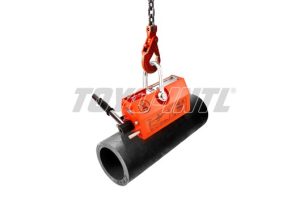
A permanent magnetic lifter grips by magnetic attraction. The TOYO-INTL PML is described for plate-shaped or column-shaped iron materials, with a light structure and a lever-operated on-off magnetic circuit. The operator places the unit on the load, turns the lever to the on position, and lifts through the attached lifting eye.
The mechanical-versus-magnetic difference drives every other comparison. A clamp transfers load through jaw pressure on an edge. A magnet transfers load through adhesion across a flat face. The two methods tolerate different surfaces, different shapes, and different residual effects on the part.
Side-by-Side Comparison
Note: The values below describe representative TOYO-INTL models. They are not universal limits for every plate lifting clamp or every permanent magnet lifter.
| Comparison point | Plate lifting clamp (TOYO CDH / CD example) | Permanent magnetic lifter (TOYO PML / PML-A example) |
| Core gripping principle | Mechanical jaw pressure on the plate edge; load applies self-tightening force as lift starts. | Magnetic adhesion across a flat face; lever switches the permanent magnetic circuit on and off. |
| Material it can lift | Steel plates and steel structures; CDH page states plate surface hardness below HRC30 / Brinell 300. | Ferrous (iron) materials only, per the PML description of iron materials and workpieces; non-magnetic metals cannot be lifted by magnet. |
| Surface and contact condition | Clamps the edge; CDH page limits surface hardness; coated, oily, or scale-covered edges need confirmation. | Needs a flat, clean face with minimal air gap; the PML-A data plate shows a thickness-versus-capacity graph, so thinner or uneven faces reduce effective holding. |
| Orientation and turning | CDH lifts vertically; the CD clamp lifts and turns a load through 180 degrees with a double-locking latch. | Mostly vertical lift of flat plates or round bars; turning or spinning the load is not controlled by the magnet itself. |
| Published capacity example | CDH: WLL 0.8-30 t; jaw opening 0-16 mm up to 80-220 mm by model. | PML: rated 100-5,000 kg, max pull 300-15,000 kg; PML-A: steel plate 100-2,000 kg, round steel 50-1,000 kg, maximum pull force 3.5 times the rated load. |
| Residual effect on the load | No magnetic residue; mechanical grip leaves no magnetism in the part. | Possible residual magnetism on thin or machined parts after the magnet is switched off; exact residual level is To be confirmed on the TOYO product pages. |
| Main inspection focus | Forged eye, cam/jaw condition, pivot pins, spring lock, markings and jaw opening. | Magnetic contact face cleanliness, lever operation, lifting eye, data plate, and load-thickness match. |
| Best-fit condition | Vertical lifting, edge reachable, turning required, or loads where magnetism on the part must be avoided. | Flat, clean, ferromagnetic plates or round bars where no edge clamping point is convenient and cycle speed matters. |
When a Plate Lifting Clamp Fits Better
Choose a plate lifting clamp when the load is not suitable for magnetic adhesion. A stainless steel plate, an aluminum plate, a painted or coated face, or a part that must stay non-magnetic rules out a permanent magnet and points to a mechanical clamp.
Choose a clamp when you need to turn the load. The TOYO-INTL CD clamp is described for lifting and turning a load through 180 degrees, with the load positively retained during lifting and turning. That turning action is controlled by the clamp, not by a magnet resting on top of the plate.
Choose a clamp when the edge is accessible and the jaw opening matches. The CDH table spans jaw openings from 0-16 mm on the smallest model to 80-220 mm on the 30-tonne model. If the plate thickness falls inside a model’s published opening range and the surface hardness is below HRC30 / Brinell 300, the clamp is a candidate.
When a Permanent Magnetic Lifter Fits Better
Choose a permanent magnetic lifter when the load is flat, clean, ferromagnetic, and has no convenient edge to clamp. The PML is described for plate-shaped or column-shaped iron materials in factories, docks, warehouses, and transport.
Choose a magnet when fast, repeated attachment matters. A magnet attaches to a flat face in seconds and does not need to be threaded onto an edge. The PML-A publishes separate ratings for steel plate (100-2,000 kg) and round steel (50-1,000 kg), so round bars can be considered where a clamp jaw would need special shaping.
Choose a magnet only after confirming thickness and air gap. Magnetic holding drops when the plate is thin, scaled, painted, or not flat against the pole face. The PML-A data plate carries a capacity graph that relates holding to the load, so the buyer must match the actual plate thickness to that curve rather than reading only the headline rated weight.
Material and Surface Limits You Must Confirm
Material compatibility is the hard boundary. As a general engineering rule, a permanent magnet lifter lifts only ferromagnetic materials. It will not lift austenitic stainless steel, aluminum, copper, or other non-magnetic metals. This is a physical limit of magnetic gripping, not a TOYO-INTL product claim.
For clamps, the published limit is surface hardness. The TOYO-INTL CDH page states the clamp is for plate surface hardness below HRC30 / Brinell 300. Harder work-hardened or quenched surfaces should not be assumed to grip; confirm before use.
Two items remain To be confirmed on the public product pages. First, the exact residual magnetism left on a part after the PML or PML-A is switched off. Second, the published derating for painted, scaled, or rough surfaces on the magnet side. Treat thin finished plates and magnet-sensitive parts as requiring confirmation.
What to Include in a Clamp-vs-Magnet Review
Send the following information so the supplier can review the gripping method and the model:
- Load material grade and magnetic type (carbon steel, stainless, aluminum, other)
- Plate or bar dimensions: length, width, and actual thickness
- Weight of the load and center of gravity
- Surface condition: bare steel, paint, mill scale, oil, rust, or machined finish
- Required lift direction: vertical, horizontal, or 180-degree turning
- Whether residual magnetism on the part is acceptable
- Cycle frequency and indoor/outdoor environment
- Destination country and required documents or certification
Frequently Asked Questions
Is a plate lifting clamp or a magnetic lifter safer?
Neither is safer in general. Safety depends on matching the tool to the material, surface, and thickness, and on following the published working load limit and jaw or face rating. A clamp on a non-magnetic edge is the right tool for one job; a magnet on a dirty, thin, non-ferrous plate is the wrong tool for another.
Can a permanent magnetic lifter lift stainless steel?
Not if the stainless is a non-magnetic austenitic grade. Permanent magnets rely on ferromagnetic attraction. Confirm the steel grade and magnetic response before selecting a PML or PML-A.
Does the magnet leave the part magnetic afterward?
Possible. Thin or machined parts can retain some residual magnetism after the magnet is switched off. The exact residual level for the TOYO-INTL PML/PML-A is To be confirmed on the public pages, so confirm before lifting magnet-sensitive components.
Which one handles turning a plate over?
A mechanical clamp is the controlled choice for turning. The TOYO-INTL CD clamp is described for lifting and turning through 180 degrees with the load positively retained. A magnet resting on a flat face does not control a flip.
Is the headline rated weight the only number I need?
No. For clamps, match the jaw opening to the actual plate thickness and respect the HRC30 / Brinell 300 hardness limit. For magnets, match the actual plate thickness and flatness to the published capacity graph, because holding depends on air gap and thickness.
Conclusion
A plate lifting clamp and a permanent magnetic lifter solve the same lifting problem with two different gripping principles. Choose the clamp for vertical lifts, turning, non-magnetic or coated loads, and parts that must stay free of magnetism. Choose the magnet for flat, clean, ferromagnetic plates or bars where edge clamping is inconvenient.
The most useful next step is to send the load dimensions, material grade, and surface condition and ask TOYO-INTL to confirm the gripping method, model, capacity, and surface limits before ordering.
Sources & Verification
Reviewer: TOYO Content Team
Last reviewed: 2026-10-12
Source URLs (TOYO-INTL public product pages, accessed during preparation):
- https://www.toyointl.com/product-category/lifting-clamp-magnet-lifter/
- https://www.toyointl.com/product/toyo-intl-cdh-lifting-clamp/
- https://www.toyointl.com/product/toyo-intl-cd-lifting-clamp/
- https://www.toyointl.com/product/toyo-intl-pml-permanent-magnet-lifter/
- https://www.toyointl.com/product/toyo-intl-pml-a-permanent-magnet-lifter/
Note: All TOYO-INTL model codes, working load limits, jaw openings, and pull-force figures above are taken from the public product pages listed here. Where a field is not stated on those pages, this article marks it as To be confirmed rather than estimating it. This article gives conditional guidance and does not declare a universal winner between the two gripping methods.