



Width alone cannot tell you which ratchet strap you need. TOYO-INTL lists 25 mm models rated from 1,000 kg to 1,500 kg working load, and 50 mm models rated from 2,000 kg to 5,000 kg. The rating sits on the model, not on the width: the strongest 50 mm model carries 2.5 times the rating of the weakest. So compare the rating label first, then width, end fittings, anchor points, and length.
If your loads stay at or below about 1,500 kg and you want a lighter strap, the 25 mm DL010 or DL015 covers the job. If you lash 2,000 kg or more, choose a 50 mm model from DL020 to DL050. If your market requires a specific rating system, confirm that before you pick a width.
Key Takeaways
- Width narrows the choice; the rating label decides. TOYO-INTL publishes working load in kg per model, not per width.
- 25 mm DL models: 1,000-1,500 kg working load, 4-8 m working length.
- 50 mm DL models: 2,000-5,000 kg working load, 4-12 m working length.
- Four models come in 50 mm webbing, yet their working loads run from 2,000 kg to 5,000 kg. The strongest is rated 2.5 times the weakest.
- DL020 and DL030 each come in 38 mm or 50 mm and keep the same working load in both widths, which proves width is not the rating.
- Compare like with like: match unit to unit and load type to load type. Never set a working load figure against a breaking load figure.
Quick Comparison: 25 mm vs 50 mm Ratchet Straps
| Attribute | 25 mm (1 in) | 50 mm (2 in) |
| Published TOYO-INTL models | DL010, DL015 | DL020, DL030, DL040, DL050 |
| Working load range | 1,000-1,500 kg | 2,000-5,000 kg |
| Working length range | 4-8 m | 4-12 m |
| Typical cargo | Tools, pallets, appliances, light machinery | Machinery, steel, building materials, heavy pallets |
| Handling | Lighter strap, faster to thread and tension | Heavier webbing, higher tension capacity |
Note: these values describe the TOYO-INTL DL models published at the time of writing. They are not universal rules for every 25 mm or 50 mm strap on the market. Always check the specification of the exact model and length you buy.
Can Width Alone Tell You Which Strap Fits?
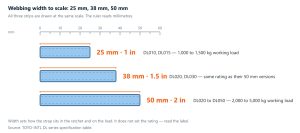
No. Width tells you the strap class, not the capacity. In the TOYO-INTL DL lineup, four models come in 50 mm webbing: DL020 at 2,000 kg, DL030 and DL040 at 3,000 kg, and DL050 at 5,000 kg. The strongest of them is rated 2.5 times the weakest, all inside one width.
The reverse also holds. DL020 keeps 2,000 kg in either 38 mm or 50 mm webbing, and DL030 keeps 3,000 kg in either. One rating can live in two widths. Buy from the rating first, then check that the width suits your ratchet, hooks, and handling.
What Should You Read on the Label?
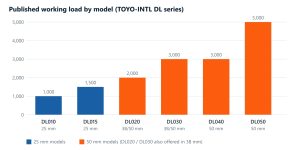
Fig 2. Working load in kg per published DL model. Color shows webbing width; note how far the ratings spread inside one width. Source: TOYO-INTL DL series specification table.Find the working load first. TOYO-INTL publishes working load in kilograms for each DL model, for example 1,000 kg for DL010 and 5,000 kg for DL050. The sewn-in label should state this rating and stay legible for the life of the strap.
Compare like with like: match unit to unit and load type to load type, whether the label reads kilograms, pounds, or daN. Breaking load describes failure, not safe use, so never quote it against another supplier’s working load.
Rating systems differ by market, and each one names the number differently:
- European Union – lashing capacity (LC) in daN, on the label required by EN 12195-2
- United States – working load limit (WLL) in pounds, following WSTDA practice
- TOYO-INTL published data – working load in kilograms, per DL model
TOYO-INTL publishes working load in kilograms for every DL model. If you sell into the EU or the US, ask the supplier to restate that model in the system your market applies. One question at the quotation stage prevents a shipment that is labelled correctly but rated under the wrong system.
How Is the Webbing Built?
Ratchet strap webbing is woven from high-tenacity polyester yarns. Polyester resists stretch and keeps most of its strength when wet, which is why it is the standard material for tie-downs. What matters at purchase is the condition you get and can keep: intact edges, no cuts, and no UV fading.
Inspect the webbing before every use. Replace a strap that is cut, burnt, or abraded at an edge. Damage to a few surface yarns can remove a large share of the strength even when the strap still looks whole.
Which Ratchet and End Fittings Do You Need?
The ratchet is the tool that tensions and locks the webbing. TOYO-INTL DL models use a manual ratchet handle with double J-hooks on the ends. A longer handle gives more leverage on stiff 50 mm webbing; a compact handle fits tight lashing positions. Try the handle stroke before you standardize on one model.
End fittings decide where the strap can attach. Double J-hooks suit side rails and lashing points; S-hooks suit closed eyes; flat hooks sit on rub rails; endless webbing loops around the cargo itself. Match the hook to the anchor, not the other way round. If your job needs a fitting outside the standard set, ask for the options list.
Will It Fit Your Anchor Points?
Check three things: hook opening, anchor shape, and pull direction. The hook must seat fully in the anchor point, not rest on its tip. The webbing must pull in a straight line from anchor to cargo. A strap pulled around a sharp corner works below its rating and wears fast.
Use corner protection wherever webbing crosses an edge. Route straps away from moving parts so nothing rubs during transport.
How Long Should the Strap Be?
Buy the working length for your real loads, not the maximum on the chart. TOYO-INTL lists 25 mm DL models at 4-8 m and 50 mm models at 4-12 m. The strap must wrap the load, reach both anchors, and leave enough free end to thread the ratchet.
A strap that is too short cannot be tensioned at all. A strap that is much too long leaves a loose tail that flaps at speed. If you carry mixed loads, two lengths beat one compromise.
What About Handling and Storage?
Thread the free end through the spool slot, pull the slack tight by hand, then pump the handle until the load sits firm. The pawl locks as you pump and holds the tension in transit. To release, press the release lever and open the handle flat. If you are new to the sequence, see How to Use a Ratchet Tie Down: A Step-by-Step Guide.
Store straps dry and out of direct sun, coiled and off the floor. Do not twist the webbing when threading: a twist reduces the bearing area, jams the spool, and wears the edge. Keep hooks clear of mud and grit so they latch cleanly.
Do You Need an Auto-Retract Option?
An auto-retract ratchet strap winds its own slack back into the case, so the loose tail never drags over the load. Fleet operators value it because it speeds up turnaround and keeps straps off the ground.
TOYO-INTL’s published DL lineup does not list an auto-retract model at the time of writing. If your operation needs that option, confirm availability with TOYO-INTL before you standardize on a width.
Which TOYO-INTL Models Show the 25/50 mm Choice?
- DL010 – 25 mm (1 in), 1,000 kg working load, 4-8 m working length
- DL015 – 25 mm (1 in), 1,500 kg working load, 4-8 m working length
- DL020 – 38 mm (1.5 in) or 50 mm (2 in), 2,000 kg working load, 4-8 m working length
- DL030 – 38 mm (1.5 in) or 50 mm (2 in), 3,000 kg working load, 4-12 m working length
- DL040 – 50 mm (2 in), 3,000 kg working load, 4-12 m working length
- DL050 – 50 mm (2 in), 5,000 kg working load, 4-12 m working length
DL080 (75 mm) and DL100 (100 mm) sit outside this comparison. They serve loads from 8,000 kg upward.
How Should You Choose? A Short Decision Path
- Write down the heaviest load you will lash and the rating system your market requires.
- Pick candidate models by working load, not by width, and check each label.
- Shortlist widths that suit your handling: 25 mm for loads up to about 1,500 kg, 50 mm from 2,000 kg.
- Match the end fittings to your anchor points and check that the pull runs straight.
- Choose a working length that wraps the load with spare end for the ratchet, and confirm storage rules and any auto-retract need with the supplier.
- Send the inquiry with the six items listed below.
What Should You Include in an Inquiry?
Send TOYO-INTL these six items and you will get a quotable answer in one round:
- The rating system your market requires (kg working load, or the standard your region applies)
- The working load you need per strap
- The working length or lengths you need
- The end fittings for each end
- Your anchor points, with photos if they are unusual
- Your target market and order quantity
FAQ
Is a 50 mm ratchet strap always stronger than a 25 mm strap?
No. The rating belongs to the model, not the width. TOYO-INTL rates its 25 mm DL models at 1,000-1,500 kg working load and its 50 mm models at 2,000-5,000 kg. Within 50 mm, DL050 is rated 2.5 times DL020.
Can width alone tell me which strap I need?
No. Width narrows the field, but the rating label decides. DL020 keeps 2,000 kg in either 38 mm or 50 mm webbing, and DL030 keeps 3,000 kg in either, so one rating can live in two widths.
What does working load mean on a ratchet strap label?
Working load is the maximum load the manufacturer allows the strap to hold in normal use. TOYO-INTL publishes it in kilograms for each DL model. Do not confuse it with breaking load, which describes failure, not safe use.
How tight should I tension a ratchet strap?
Tension until the load cannot shift when you push it by hand, then stop. Overtightening can crush light cargo and strains the webbing and hooks. Check the tension again after the first part of the journey.
Does strap length change the rating?
No, within a model’s published working length range. TOYO-INTL lists working lengths per model, such as 4-8 m for DL010. The rating applies across that range; confirm any length outside it with the supplier.
Conclusion
25 mm and 50 mm ratchet straps answer different jobs. The 25 mm DL models carry 1,000-1,500 kg working load over 4-8 m; the 50 mm models carry 2,000-5,000 kg over 4-12 m. Width is the second decision, not the first. Read the rating label, match the end fittings to your anchors, then pick the length. If you are unsure, send TOYO-INTL your load, length, fittings, anchor points, and target market, and the team will match a model.
Need help choosing? Send TOYO-INTL your rating system, required lengths, end fittings, anchor points, and target market. The team will reply with a matched DL model and a quotation.
Sources: TOYO-INTL DL series ratchet strap specifications, toyointl.com (table supplied by client; live page URL to be confirmed). Last reviewed: September 2026.