


Polyester and polypropylene are the two webbing fibres used for tie-downs, and they are not interchangeable. Polyester carries more load, stretches less and resists sunlight, so it is the default for outdoor and repeated heavy securement. Polypropylene resists acid and alkali, floats and costs less, so it is the choice for wet chemical loads and one-way shipments. The two fibres look alike in a finished strap; the difference shows only in the data sheet and the price.
This article compares the two on the seven properties that decide a tie-down: tenacity, elongation, ultraviolet resistance, chemical resistance, water uptake, temperature range and weight. A buyer who reads the seven against the load — outdoor or indoor, repeated or one-way, clean or chemical — picks the right fibre on the first order.
Key Takeaways
- Polyester is the default for outdoor, repeated and heavy tie-downs; polypropylene is the default for wet chemical and one-way loads.
- Polyester carries roughly 1.5 times the tenacity of polypropylene at the same width.
- Polyester stretches 6 to 12 percent at break; polypropylene stretches 15 to 25 percent. Lower stretch holds tension; higher stretch absorbs shock.
- Polypropylene resists acid and alkali far better than polyester; polyester resists most solvents better than polypropylene.
- Polypropylene absorbs under 0.1 percent water and floats; polyester absorbs under 1 percent and still loses little strength wet.
- Polyester holds to about 100 °C continuous; polypropylene softens near 80 °C and melts at 160 °C.
Quick Comparison Table
| Property | Polyester (PES) | Polypropylene (PP) |
| Tenacity | 7–9 g/denier | 4–6 g/denier |
| Break elongation | 6–12% | 15–25% |
| UV resistance | Good | Poor (unless stabilised) |
| Acid resistance | Moderate | Excellent |
| Alkali resistance | Moderate | Excellent |
| Water absorption | <1% | <0.1% |
| Continuous service temp | −40 to 100 °C | −40 to 80 °C |
| Melting point | ~250 °C | ~160 °C |
| Specific gravity | 1.38 | 0.91 (floats) |
| Relative cost | Mid to high | Low |
Note: The numbers above describe the raw fibre and the published behaviour of common webbing grades. A finished tie-down’s working load limit (WLL) depends on width, stitching, end hardware and the standard it is built to. Confirm the WLL on the sewn label, not the fibre data sheet.
Tenacity and Working Load
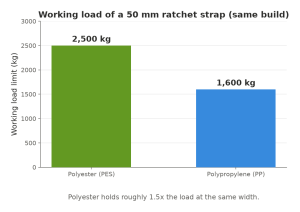
Polyester fibre carries 7 to 9 grams per denier; polypropylene carries 4 to 6 grams per denier. At the same webbing width and stitch pattern, a polyester tie-down holds roughly 1.5 times the load of a polypropylene tie-down. A 50 mm polyester strap rated 2,500 kg working load in a common ratchet configuration outscales a 50 mm polypropylene strap of the same build, which typically lands near 1,500 to 1,700 kg.
The ratio holds inside the WLL, not just at break. Polyester keeps its working load under long tension; polypropylene creeps more under sustained load and loses tension over a day on the road. For a load that must stay clamped from loading dock to destination, polyester is the safer fibre.
Elongation and Tension Holding
Polyester stretches 6 to 12 percent at break; polypropylene stretches 15 to 25 percent. The difference decides how a strap behaves after it is tensioned. A polyester strap pulled to working load holds that tension: low stretch means the webbing does not creep back and slack the load. A polypropylene strap pulled to the same tension stretches more, then relaxes as the load settles, and a strap that was tight at the dock can sit loose after the first corner.
High elongation is not a fault when the load shocks. Polypropylene absorbs sudden snatches better than polyester because it gives before it holds. For a fragile load on a rough road, the give protects the load; for a steel coil on a flatbed, the give loses the clamp. Match the fibre to the load: stable heavy loads want polyester; shock-prone fragile loads can use polypropylene.
Ultraviolet Resistance
Polyester resists ultraviolet light well; polypropylene resists it poorly unless a UV stabiliser is added. Sunlight degrades unstabilised polypropylene in months, turning it brittle and cutting the breaking strength by half or more over a season of outdoor exposure. Polyester holds most of its strength over the same period.
For any tie-down that lives outdoors — flatbeds, open trailers, marine deck cargo — polyester is the default. Polypropylene belongs in shaded or indoor use, or in one-way shipments where the strap is cut off and discarded after a single trip. A UV-stabilised polypropylene strap carries a stabiliser add-on and a higher price; at that price a buyer is usually better served by polyester.
Chemical and Water Resistance
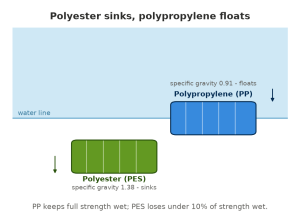
Polypropylene resists acid and alkali far better than polyester. Concentrated acids, caustic soda and wet alkaline loads that would hydrolyse a polyester strap leave polypropylene largely intact. Polypropylene also absorbs under 0.1 percent water, so it keeps full strength wet and floats. Polyester absorbs under 1 percent water and loses a small fraction of strength wet — under 10 percent in common grades — and sinks.
The chemical picture reverses for solvents. Polyester resists most common solvents, oils and fuels better than polypropylene. A tie-down on a clean dry steel load picks polyester; a tie-down on a wet acid or caustic load picks polypropylene. A tie-down on a fuel or solvent splash picks polyester again.
Temperature Range
Polyester serves continuously from −40 to 100 °C; polypropylene serves from −40 to 80 °C. Polyester melts near 250 °C; polypropylene melts near 160 °C. Neither fibre belongs near a hot exhaust or a molten metal splash, but polyester stands more heat before it softens.
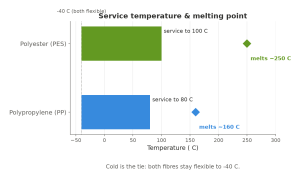
Cold is the equaliser. Both fibres stay flexible to −40 °C, so winter securement does not choose between them on temperature. A buyer who works a cold-climate route can pick on the other six properties and treat the temperature range as a tie.
Weight and Handling
Polypropylene has a specific gravity of 0.91 and floats; polyester sits at 1.38 and sinks. The weight difference is small in a single strap but adds up across a load: a full set of polypropylene tie-downs weighs roughly two-thirds the same set in polyester. For a one-way shipment where the straps are not coming back, the lighter fibre cuts freight and waste cost.
Handling differs too. Polyester webbing feels stiffer and grips the ratchet spindle firmly; polypropylene feels slicker and can slip on the spindle under high torque. A ratchet operator who tensions by hand prefers polyester for the grip; a one-way shipper who cuts the strap on arrival prefers polypropylene for the cost.
Decision Tree
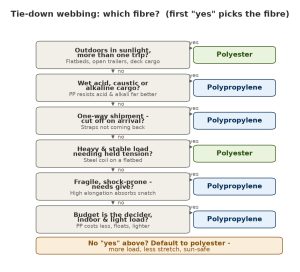
- Is the load outdoors in sunlight for more than a single trip? If yes, pick polyester.
- Is the load a wet acid, caustic or alkaline cargo? If yes, pick polypropylene.
- Is the strap a one-way shipment, cut off on arrival? If yes, pick polypropylene.
- Is the load heavy and stable, needing held tension across the road? If yes, pick polyester.
- Is the load fragile and shock-prone, needing give to protect it? Consider polypropylene.
- Is the budget the deciding factor and the load indoor and light? Pick polypropylene.
RFQ Checklist
- Fibre: polyester (PES) or polypropylene (PP), stated on the quote
- Webbing width and breaking strength, not just working load
- Working load limit (WLL) on the sewn label and the standard it is built to
- UV stabiliser, if polypropylene is specified for any outdoor use
- End hardware: hooks, ratchet type and breaking load
- Length and any fixed-end versus adjustable-end split
- Certification mark and the test report that backs the WLL
FAQ
Which tie-down webbing is better for outdoor use?
Polyester. Polypropylene degrades in sunlight within months unless a UV stabiliser is added, while polyester holds most of its strength over a season of outdoor exposure. Any tie-down that lives on a flatbed, open trailer or deck should be polyester.
Does polypropylene webbing hold less load than polyester?
Yes. Polyester fibre carries about 1.5 times the tenacity of polypropylene at the same width, so a polyester tie-down of the same build holds roughly 1.5 times the load. A buyer who needs the higher working load at the same width picks polyester.
Why does a polypropylene strap go slack on the road?
Polypropylene stretches 15 to 25 percent at break and creeps under sustained load, so a strap tensioned at the dock relaxes as the load settles. Polyester stretches 6 to 12 percent and holds its tension better, so it stays tight across the road.
When is polypropylene the right choice over polyester?
Polypropylene is the right choice for wet acid, caustic or alkaline loads; for one-way shipments where the strap is cut off on arrival; and for indoor light loads where budget is the deciding factor. Polypropylene resists acid and alkali far better than polyester and costs less.
Does water weaken polyester tie-down webbing?
Slightly. Polyester absorbs under 1 percent water and loses under 10 percent of its strength wet. Polypropylene absorbs under 0.1 percent and keeps full strength wet. For a fully submerged load, polypropylene is the safer fibre; for a wet-but-not-submerged load, the difference is small.
Conclusion
Polyester is the default tie-down fibre because it carries more load, stretches less, resists sunlight and holds tension on the road. Polypropylene is the specialist fibre because it resists acid and alkali, floats, weighs less and costs less. The two are not interchangeable: a polyester strap on a wet caustic load hydrolyses, and a polypropylene strap on an outdoor flatbed degrades. Read the seven properties against the actual load — outdoor or indoor, repeated or one-way, clean or chemical — and the fibre picks itself.
To confirm the working load limit on the finished strap, [quote the fibre, the width, the end hardware and the securing standard] so the supplier matches the webbing to the load, not the price to the budget.
*Last reviewed: 2026-10-27. Fibre properties cited from the published behaviour of common polyester (PES) and polypropylene (PP) webbing grades. The working load limit of a finished tie-down depends on width, stitching, end hardware and the certifying standard; confirm the WLL on the sewn label before use.*