


To find the right chain block in the TOYO-INTL catalogue, choose the series first, then find the capacity row, then read lift, load-chain falls, chain size, hand force and Hmin from that same row. For a 2 t workshop lift, the VD-2T row publishes 2,000 kg WLL, 1 load-chain fall, 8×24 mm chain, 335 N hand force and 470 mm Hmin.
The catalogue is a set of model rows, not universal numbers. Two models can share a 500 kg or 3,000 kg rating and still differ in falls, weight and headroom. Mixing values from different rows creates a specification that no single block may match.
The Two Series in the Catalogue
The hand chain block section publishes two series: VD and VS. Pick the series before the capacity, because the two series do not publish the same field set.
| Series | Published capacity range | Standard lift | Load chain | Hand force published? | Published construction focus |
| VD | 250 kg to 20,000 kg (VD-0.25T to VD-20T) | 2 m or 2.5 m below 3 t; 3 m from 3 t | ISO high grade / G80 alloy chain | Yes, 220 N to 380×2 N | All-steel body, double pawl springs, slip clutch, sealed roller bearings |
| VS | 0.5 t to 50 t (VS-0.5 to VS-50) | 2.5 m below 2 t; 3 m from 2 t | Grade 100 chain, WAFIOS link, DIN standard | No; the column is blank | Grade 100 chain, traceable forged hooks, double-pawl fail-safe brake |
The two series overlap between 0.5 t and 20 t. In that overlap, capacity alone never chooses the model. The VD sheet publishes hand force and dimensions A, B, C and Hmin. The VS sheet publishes a running test load and extra weight per metre of extra lift, with net weight rising from 8.7 kg to 1,092 kg across the range.
VD construction includes a slip-clutch overload device, sealed roller bearings and a double enclosed brake cover that keeps out dust, rain and dirt. The 2024 TOYO-INTL catalogue states that the VD design passed more than 1,500 cycles of EN 13157 endurance testing. VS uses forged and heat-treated load hooks with batch traceability and stretch indicators, asbestos-free brake linings and a forged safety latch. Each VS unit is proof-load tested to 1.5 times WLL with an individual serial number.
Note: These series descriptions summarise published TOYO-INTL catalogue data. They are not a general rule for all chain blocks. Confirm the current sheet for the model you intend to order.
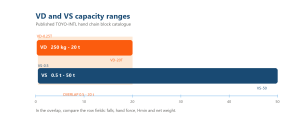
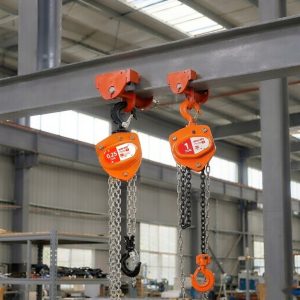
Fig 2. (left VD, right VS) Two TOYO-INTL hand chain blocks on beam trolleys clamped on one I-beam; each top hook hangs from its trolley ring, not the bare beam.
The Six Fields to Read in One Row
Read across one row. The table reproduces two published rows, VD-2T and VS-2, so each field stays attached to its value.
| Field (published label) | VD-2T | VS-2 |
| W.L.L. / Capacity | 2,000 kg | 2 t |
| Lift / Standard lift | 2.5 m | 3 m |
| Load-chain falls | 1 | 2 |
| Load-chain size | 8×24 mm | 8×24 mm |
| Hand force | 335 N | Not published |
| Net weight | 19.5 kg | 14.6 kg |
| Hmin | 470 mm | 440 mm |
Note: These values describe two published configurations. They are not a general rule for all 2 t chain blocks. The exact model row on the supplier sheet governs selection.
What Each Field Tells You
WLL or Capacity
WLL is the maximum load the block is rated to lift. TOYO-INTL prints it in kilograms on the VD sheet, from 250 to 20,000 kg, and in tonnes on the VS sheet, from 0.5 to 50 T. Both figures describe one chain block, not a pair. Convert the unit before comparing rows: 2 t and 2,000 kg are the same rating.
Standard Lift
Standard lift is the hook travel supplied as standard, 2.5 m on VD-2T and 3 m on VS-2. It is not the maximum lift the block can reach. The VS sheet publishes an extra weight per metre of extra lift: 2.4 kg per metre on VS-2 and 49.4 kg per metre on VS-50. A longer load chain adds weight the suspension point must carry.
Load-Chain Falls
Load-chain falls is the number of load-chain strands supporting the hook. VD-2T has 1 fall and VS-2 has 2. The number is not a capacity multiplier and it is not a hook count. A 2 fall block runs the chain through an extra sheave, which changes hook speed, hand force and headroom.
Load-Chain Size
Load-chain size is printed as diameter by pitch in millimetres, such as 8×24 mm on both rows above. The VD range runs from 4×12 mm on VD-0.25T to 10×30 mm on VD-3TS. The VS range uses 6×18, 8×24 and 10×30 mm. Read chain size together with falls: one model carries 3 t on a single 10×30 mm strand, while another carries the same 3 t on two 7.1×21 mm strands.
Hand Force
Hand force is the pull required at the hand chain to lift the maximum load. Only the VD sheet publishes it, from 220 N on VD-0.25T to 380 N on VD-10T. VD-20T prints 380×2 N, meaning two operators sharing the pull. A blank VS hand-force column is missing data, not a zero-effort rating.
Net Weight and Hmin
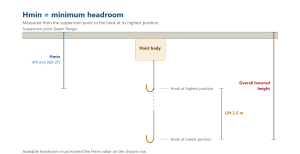
Net weight is the block without packaging; the VS sheet lists a separate packing measurement. Hmin is the minimum headroom, the shortest distance from the suspension point to the hook in its top position. VD-2T publishes 470 mm, VS-2 publishes 440 mm and VS-50 publishes 2,578 mm. Hmin decides whether the block fits the beam, bracket or trolley you plan to hang it from.
Why Two Models Share One Capacity
Three pairs in the catalogue make the same point: capacity alone never identifies a row.
VD-0.5T(MINI) and VD-0.5T both rate 500 kg. The MINI weighs 6.5 kg, uses a 5×15 mm chain, needs 250 N and has 310 mm Hmin. The standard VD-0.5T weighs 11 kg, uses the same 5×15 mm chain, needs 240 N and has 345 mm Hmin. The MINI fits tighter headroom; the standard model gives a 2.5 m lift against the MINI 2 m.
VD-3TS and VD-3T both rate 3,000 kg. VD-3TS runs one 10×30 mm fall at 363 N, weighs 29 kg and needs 565 mm Hmin. VD-3T runs two 7.1×21 mm falls at 265 N, weighs 23.5 kg and needs 490 mm Hmin. The two rows trade chain thickness against hand force and headroom at the same rating.
VD-2T and VS-2 both rate 2 t. VD-2T uses one 8×24 mm fall and publishes 335 N hand force. VS-2 uses two 8×24 mm falls and does not publish hand force. VS-2 is lighter at 14.6 kg against 19.5 kg, has 440 mm Hmin against 470 mm and ships with a 3 m standard lift against 2.5 m.
Keep the Field Names as Printed
Copy the field name and unit from the sheet. Load-chain falls is a strand count, not a capacity. Hmin is headroom, not hook travel. Standard lift is the supplied chain length, not a maximum. Running test load on the VS sheet is a factory test value, not the WLL.
Keep the full model code beside every number. VD-3T and VD-3TS differ by one letter and describe different rows.
Start in the Right Section
The TOYO-INTL catalogue lists hand chain blocks, lever hoists, electric wire rope hoists and electric chain hoists as separate categories. The VD and VS tables belong to the hand chain block category only. A hand force copied from a lever hoist table does not transfer to a chain block sheet.
What to State in an Inquiry
A useful inquiry gives the supplier enough detail to confirm a row:
- Maximum load in kilograms or tonnes, and whether the load moves or stays static
- Required hook travel and any extra lift beyond the standard length
- Available headroom at the suspension point, measured in millimetres
- Series preference, VD or VS, and the working environment
- Number of operators and any limit on hand force
- Target market and the documents the buyer needs, such as CE or ISO files
Describe each job separately if the load or headroom changes by site. The supplier can then confirm which published row fits each case.
How to Find the Row in Five Steps
Step 1: Open the Hand Chain Block Section
Use the hand chain block category, not lever hoist or electric hoist. Confirm the series name, VD or VS, printed above the table.
Step 2: Choose the Series by Range and Field Set
Pick VS if the load exceeds 20 t, since only VS reaches 30 t and 50 t. Inside the overlap, choose VD when you need a published hand force or the A, B, C and Hmin dimensions, and VS when you need the extra-weight-per-metre data.
Step 3: Find the Capacity Row
Locate the row whose WLL or capacity covers the load. A 2,000 kg load fits VD-2T or VS-2. A 2,100 kg load fits neither; move to the next published row instead of rounding down.
Step 4: Read Across the Row
Record falls, chain size, hand force, net weight and Hmin from that row before judging fit. A correct capacity cannot fix a block whose Hmin exceeds the available headroom.
Step 5: Record the Full Model Code
Write the complete code beside every value and ask the supplier to confirm it in the quotation. VD-3T, VD-3TS and VS-3 all contain a 3 but publish different rows.
Common Reading Mistakes
Selecting by capacity alone is the most common error. Three pairs above show why two blocks at the same rating differ in weight, chain and headroom. Mixing rows is the second error: a hand force from VD-3TS combined with the net weight of VD-3T describes no published model.
A third mistake is reading the running test load as the working load limit; the two are separate fields on the VS sheet. Ignoring Hmin causes fit failures on low-headroom beams and trolleys. Assuming VS publishes hand force is another error: the column is blank across all ten VS rows.
FAQ
How do I tell VD and VS apart in the catalogue?
VD covers 250 kg to 20 t and prints hand force plus A, B, C and Hmin dimensions. VS covers 0.5 t to 50 t and prints running test load and extra weight per metre of extra lift. The ranges overlap from 0.5 t to 20 t.
Why do two models share the same 500 kg or 3,000 kg rating?
They are different configurations of one rating. VD-0.5T(MINI) is lighter and shorter in lift than VD-0.5T. VD-3TS uses one thick chain fall; VD-3T uses two thinner falls at lower hand force.
What does load-chain falls mean?
It is the number of load-chain strands that support the hook. VD-2T has one fall and VS-2 has two. The count changes hook speed, hand force and headroom; it does not change the published WLL.
Does a longer lift change the specification?
Yes. The VS sheet publishes extra weight per metre of extra lift, from 1.6 kg/m on VS-0.5 to 49.4 kg/m on VS-50. Confirm the total chain length and added weight with the supplier before ordering.
Is hand force published for every model?
No. All eleven VD rows publish it, from 220 N to 380×2 N. All ten VS rows leave the field blank. Ask TOYO-INTL for hand-force data if operator effort is a selection criterion.
Conclusion
A TOYO-INTL chain block catalogue is read one row at a time. Choose VD or VS, find the capacity, then read lift, falls, chain size, hand force, net weight and Hmin together. VD-2T and VS-2 both carry 2 t, but the published rows describe two different blocks.
Before ordering, state the load, hook travel, available headroom and operator limits. Ask TOYO-INTL to confirm the model code and every field in the quotation and technical documents.
Sources: TOYO-INTL 2025 and 2024 product catalogues, VD and VS chain block specification tables; TOYO-INTL VD Chain Hoist product page; TOYO-INTL hand chain block category.