



The TOYO-INTL DL Cargo Lashing series covers working-load ratings from 1,000 kg to 10,000 kg and webbing widths from 25 mm to 100 mm. The most useful way to choose among these options is by cargo scenario rather than by declaring one strap universally best.
This article maps five cargo types to the conditions that change with load shape, edge sharpness, rolling tendency, and vehicle type. The order is not a best-to-worst ranking. Regulatory references are jurisdiction-specific and are labeled as such.
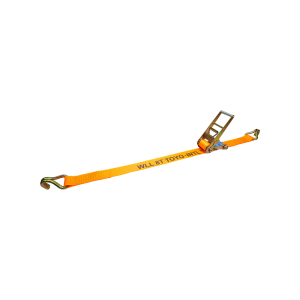
Figure 1 — DL080 ratchet tie-down strap, 8,000 kg working load, 75 mm webbing. One model from the DL range; the published table spans 1,000 to 10,000 kg across 25–100 mm widths.
Ratchet tie-down straps secure cargo on a flatbed trailer. Strap width, WLL, and edge protection must match the cargo and the jurisdiction’s securement rules.
Five Cargo Scenarios at a Glance
| Cargo scenario | Main movement risk | Strap width / DL model range | Key accessories or rules |
| Palletized general cargo | Forward tipping, side shift | 25–50 mm; DL010–DL040 | Edge protectors, corner boards, no knots |
| Machinery / heavy equipment | Tip-over, roll, slip under tension | 50–75 mm; DL040–DL080 | Chain slots, anti-slip pads, direct tie-down |
| Sharp-edged steel (plates, profiles) | Webbing cutting at contact edge | 50–75 mm with edge-cut-resistant tape | Mandatory edge protection per FMCSA 393.104(f)(4) |
| Pipes / logs / rolling cargo | Rolling, lateral movement | 50–100 mm; DL050–DL100 | Chocks, bunks, cradles, wrappers |
| General cargo in enclosed box truck | Stack shift, load wall collapse | 25–50 mm; DL010–DL030 | E-track or anchor-point hooks, load shoring |
1. Palletized General Cargo
Palletized cargo moves mainly through forward tipping and lateral sliding. The strap must hold the pallet stack against the deck without crushing the top cartons. Webbing that is too wide can dig into soft pallet edges; webbing that is too narrow may cut through stretch wrap.
The TOYO-INTL DL010 and DL015 use 25 mm (1-inch) webbing at 1,000 kg and 1,500 kg working loads, with 4–8 m lengths. The DL020 and DL030 widen to 38 mm or 50 mm at 2,000 kg and 3,000 kg. These lower-rated widths are the typical starting point for pallet runs on box trucks and curtain-sided trailers.
Under the U.S. FMCSA rules, a load must pass two separate tests: a count test and a strength test. Failing either one is a violation, and passing one does not excuse the other.
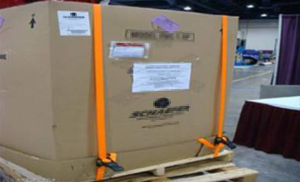
Figure 2 — Cartons on a wooden pallet secured with two over-the-top straps anchored to deck rings. Both straps return to the same side of the vehicle and are credited at 50 percent under 49 CFR 393.106(d), and the webbing bears directly on the carton corners with no edge protection.
The count test, 49 CFR 393.110, sets how many tiedowns are required based on the length and weight of the article: an article not blocked forward needs one tiedown if it is 5 ft (1.52 m) or shorter and 1,100 lb (500 kg) or lighter; two tiedowns if it is 5 ft or shorter but more than 1,100 lb, or if it is longer than 5 ft and not more than 10 ft (3.04 m); and two plus one additional tiedown for every 10 ft beyond the first 10 ft.
The strength test, 49 CFR 393.106(d), is a single number: the combined working load limit of every tiedown used must be at least half the weight of the article. Combined is the operative word. Each strap does not have to carry half the load on its own; the total of all straps together must add up to at least half. A 6,000 kg pallet load therefore needs a combined working load limit of at least 3,000 kg. Two 2,000 kg straps satisfy that on paper, and so does one 5,000 kg strap. What does not work is four 1,000 kg straps: the marked total is 4,000 kg, but every one of them is tied over the load and back to the same side of the vehicle, so each is credited at half value and the load counts as only 2,000 kg..
That halving is the part worth remembering. A tiedown running from a vehicle anchor straight to a cargo anchor — a lifting eye, a chain slot, an anchor lug — is credited at 100 percent of its marked working load limit. A tiedown that passes over the cargo and back to an anchor on the same side is credited at only 50 percent, because part of the tension pulls the load downward rather than restraining it laterally. Over-and-under tie-downs that cross to anchors on the opposite side are credited at 100 percent.
In practice this means attachment method is worth as much as strap capacity. Two straps of the same width and rating can deliver double the credited load depending on where they are anchored, and where they are anchored is usually decided by the cargo, not by the strap supplier.
| Tie-down arrangement | Marked WLL | Credited at | Contributes |
| Vehicle anchor to cargo lifting eye | 2,000 kg | 100% | 2,000 kg |
| Vehicle anchor, over the cargo, back to the same side | 2,000 kg | 50% | 1,000 kg |
| Vehicle anchor, over the cargo, across to the opposite side | 2,000 kg | 100% | 2,000 kg |
| Requirement for a 6,000 kg article | 3,000 kg minimum | ||
Three arrangements of the same 2,000 kg strap produce 2,000 kg, 1,000 kg, or 2,000 kg of credited capacity depending only on where the strap ends are anchored.
The DL040 is listed separately from the DL030 because it fixes the webbing at 50 mm (2 in) rather than offering the 38 mm (1.5 in) / 50 mm (2 in) choice. Both models carry a 3,000 kg working load; Both models carry a 3,000 kg working load and the same 4–12 m length; the difference is webbing width, not capacity.
When to review pallets
2. Heavy Machinery and Equipment
Machinery presents tipping and rolling risks rather than simple sliding. Skid-steers, excavator arms, compressors, and generator sets have high centers of gravity and often need direct tie-downs through lifting eyes or chain slots rather than over-the-top wrapping. Direct tie-downs are credited at 100 percent of their marked working load limit under 49 CFR 393.106(d), so on a machine of this class the attachment method is usually worth more than an extra strap.
The TOYO-INTL DL050 uses 50 mm webbing at 5,000 kg. The DL080 uses 75 mm (3-inch) webbing at 8,000 kg, and the DL100 uses 100 mm (4-inch) webbing at 10,000 kg. These widths are the upper end of the published DL table and are the relevant starting point for direct tie-down of heavy equipment. The DL series uses double J-hooks and 45-grade high-strength steel ratchets with electroplated colored-zinc protection.
FMCSA 49 CFR 393.110(d) exempts special-purpose vehicles carrying machinery or fabricated structural items from the length-based tiedown count, but every article must still be securely fastened. Heavy machinery should be blocked, braced, or placed on bunks in addition to being tied down.
The exemption applies to the tiedown count only. Heavy equipment is still subject to 49 CFR 393.130, which requires at least four direct tiedowns for vehicles and equipment weighing more than 10,000 lb (4,536 kg), each contributing at least 50 percent of the article’s weight. And under 393.108(a), the working load limit credited for any tiedown is the lowest WLL of any component — including the ratchet — or of the anchor points it attaches to, whichever is lower. A 10,000 kg strap on a low-rated anchor point is not a 10,000 kg tie-down.
When to review machinery
Review the 50–100 mm DL range when the load is a single heavy machine with lifting eyes, chain slots, or anchor lugs. Confirm the machine weight, center of gravity, required blocked-or-direct method, and whether edge protection is needed at any contact point. Final securement plan approval remains with the carrier and the competent person, not the strap supplier.
3. Sharp-Edged Steel Plates and Profiles
Steel plates, angles, channels, and bundled profiles have sharp corners that can slice through ordinary polyester webbing during transit. FMCSA 49 CFR 393.104(f)(4) requires edge protection whenever a tiedown would be subject to abrasion or cutting where it touches the cargo; the edge protection must resist abrasion, cutting, and crushing.
TOYO-INTL states that the DL Cargo Lashing line offers edge-cutting-resistant tapes and anti-sliding versions. The 50 mm and 75 mm widths — the DL040 and DL050 at 50 mm, the DL080 at 75 mm — are the relevant rows when the webbing must pass over a steel edge. Webbing material is ultra-high-tenacity polyester or polypropylene; the polypropylene series carries a 3-year UV guarantee for outdoor exposure.
Under EU EN 12195-2, lashing straps must be protected against sharp edges by corner protectors. A strap that contacts a raw steel edge without protection must be inspected after the trip; any cut typically triggers removal from service. The exact threshold depends on the manufacturer’s instructions and the competent person’s judgment.
When to review sharp-edged steel
Specify edge-cut-resistant webbing plus separate corner protectors whenever the strap crosses a raw steel edge. Confirm whether the destination is U.S. (WSTDA-T1 via FMCSA 393.104(e)(3)) or EU (EN 12195-2), because rating labels and test methods differ.
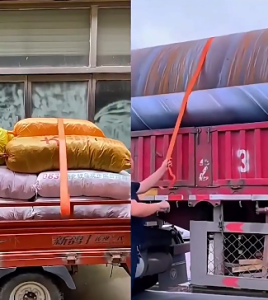
Figure 3 — Steel profiles stacked on a flatbed. The webbing bears directly on the load edge and the side board, which is exactly the contact condition 49 CFR 393.104(f)(4) addresses: edge protection must resist abrasion, cutting and crushing wherever a tiedown touches the cargo.
Cylindrical cargo rolls instead of slides. Pipes, tubes, rolls of sheet, and stacked logs need bunks, cradles, chocks, or wrappers in addition to tiedowns. A single over-the-top strap on an unchocked pipe is not an acceptable securement.
The wider DL rows (DL050 at 5,000 kg / 50 mm, DL080 at 8,000 kg / 75 mm, DL100 at 10,000 kg / 100 mm) are relevant for wrapping or direct lashing of bundled cylinders. Working lengths up to 12 m on the DL030–DL100 rows accommodate long loads.
FMCSA commodity-specific rules apply to logs (393.116) and metal coils (393.120). Pipes and tubes have no dedicated commodity section, so 393.102 governs: the securement system must be designed and installed so that forces do not exceed the manufacturer’s breaking strength under 0.8 g deceleration forward, 0.5 g acceleration rearward, and 0.5 g acceleration laterally. Under the working load limit criteria the corresponding figures are 0.435 g forward, 0.5 g rearward, and 0.25 g lateral. Chocks and cradles should be tied or weighted so they cannot walk out during braking.
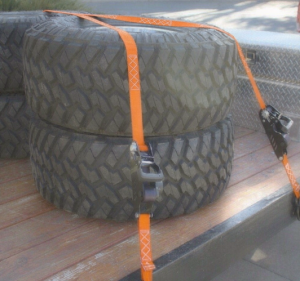
Figure 4 — An incorrect securement: tyres are wrapped with a single strap and no chocks or cradle. Under 49 CFR 393.106(c)(1), articles likely to roll must be restrained by chocks, wedges, a cradle or equivalent means; a strap alone will not hold a round load in place.
When to review rolling cargo
Review the 50–100 mm DL range when the load is cylindrical, stacked, or prone to roll. Confirm the diameter, bundle length, number of layers, and whether chocks, bunks, or a cradle are already part of the trailer. To be confirmed: TOYO-INTL does not currently publish a dedicated pipe-strap or log-strap product page; the DL rows above are general-purpose lashing straps, not commodity-specific rigging.
5. General Cargo in Enclosed Box Trucks or Vans
Inside a box truck or van, cargo does not see UV or weather, but it shifts against walls, doors, and neighboring pallets. Anchor points are typically E-track slots, D-rings, or shipper’s bars rather than flatbed winch posts.
The 25 mm DL010 and DL015 rows are the lightest published options (1,000–1,500 kg). The DL020 and DL030 cover 2,000–3,000 kg at 38–50 mm. TOYO-INTL notes automatic retractable ratchets in 25 mm and 50 mm widths, which reduce loose webbing ends. Double J-hooks are standard; buyers must confirm hook type matches the vehicle’s anchor fitting.
Indoor use removes UV concerns but increases abrasion against pallet edges and wall tracks. Polyester webbing is the default for indoor lashing; the polypropylene UV-guaranteed series suits outdoor flatbed work. If a strap carries no manufacturer marking, FMCSA does not treat it as zero capacity: 49 CFR 393.108(b) directs the user to the working load limit tables in that section. Under 393.108(a), where a marking does exist, the credited working load limit is the lowest value among any component — including the tensioner — or the anchor points to which the tiedown is attached, whichever is less.for that tiedown.
When to review enclosed cargo
Review the 25–50 mm DL range with automatic-retract ratchets when the load moves inside an enclosed vehicle with E-track or D-ring anchors. Confirm hook compatibility (J-hook vs. wire-hook vs. fitting-specific clip), required length, and whether anti-sliding webbing is needed for smooth cartons.
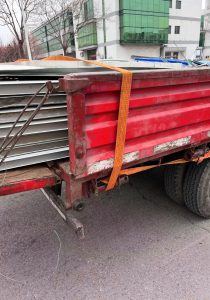
Figure 5 — Enclosed box body: the strap is anchored to a side-wall rail and tensioned inside the cargo area, where loads shift against walls and doors rather than sliding on an open deck.reinforcement
A Practical Shortlisting Sequence
- Confirm the jurisdiction: U.S. FMCSA (WSTDA-T1 webbing, 49 CFR 393) or EU EN 12195-2 (LC and STF labels).
- Match the aggregate working load limit to at least 50 percent of cargo weight under 49 CFR 393.106(d), counting direct tie-downs at full rated value and same-side over-the-top tie-downs at half.
- Select webbing width from the DL table: 25 mm for light pallet cargo, 50 mm for general machinery, 75–100 mm for heavy or wide loads.
- Add edge protection, corner boards, chocks, or cradles wherever the cargo has a sharp edge or round shape.
- Confirm hook type, length, and ratchet style against the vehicle anchor points.
- Send cargo dimensions, weight, vehicle type, anchor type, destination market, and planned securement method to TOYO-INTL for configuration confirmation.
RFQ Information to Provide
- Cargo type: pallets, machinery, steel profiles, pipes, or general cargo
- Cargo weight per item and total cargo weight
- Cargo dimensions (length, width, height) and center of gravity
- Vehicle type: flatbed, curtain-side, box truck, van, or container
- Anchor point type and rated WLL per anchor
- Destination country and applicable standard (FMCSA / WSTDA-T1 or EN 12195-2)
- Required webbing width, length, and end fitting
- Indoor or outdoor use; UV, chemical, or temperature exposure
- Whether edge protection or corner protectors are needed
Frequently Asked Questions
Which tie-down strap is best for all cargo types?
There is no universal best strap. The DL table publishes working loads from 1,000 kg to 10,000 kg across 25–100 mm widths. The correct row depends on cargo weight, shape, edge sharpness, anchor type, and destination jurisdiction.
Does a wider strap always hold more weight?
Width correlates with published working load but is not the sole factor. Under 49 CFR 393.108(a), the working load limit used for compliance is the lowest WLL of any component of the tiedown assembly, including the ratchet, or of the anchor points it attaches to, whichever is lower. A wider strap on a weaker anchor does not increase the credited capacity. Always use the marked working load limit, not the webbing width.
Can I use a 25 mm strap on heavy machinery?
The DL010 and DL015 publish 1,000 kg and 1,500 kg working loads at 25 mm. Heavy machinery typically requires the 50–100 mm rows (DL040–DL100). Using a strap below the required aggregate WLL is a compliance risk regardless of how tight it feels.
Are TOYO-INTL straps certified for the U.S. and EU markets?
The DL Cargo Lashing page states CE certification. Buyers shipping into the U.S. should confirm WSTDA-T1 label format, WLL marking, and test reports for the exact model. To be confirmed: TOYO-INTL has not published a separate WSTDA-T1 compliance statement on the DL page.
Does the order of scenarios in this article reflect quality ranking?
No. The five scenarios are organized by cargo shape and movement risk. They are not a product test, and the first scenario is not the highest-rated product.
Conclusion
Palletized cargo, heavy machinery, sharp-edged steel, rolling pipes, and enclosed-box general cargo each change at least one securement condition: strap width, edge protection, chocking, anchor type, or jurisdictional rating label. The TOYO-INTL DL Cargo Lashing series covers published working loads from 1,000 kg to 10,000 kg across 25–100 mm widths, with polyester or polypropylene webbing, double J-hooks, and optional edge-cut-resistant and automatic-retract versions.
Use these published rows to build a shortlist, then send cargo dimensions and weight, vehicle and anchor details, destination market, and planned securement method to TOYO-INTL for confirmation. This article does not approve a load-securement plan; that remains with the carrier and a competent person.
Sources & Verification
- TOYO-INTL DL Cargo Lashing product page: https://www.toyointl.com/product/toyo-intl-dl-cargo-lashing/ (model table, working loads, widths, materials, features; accessed September 2026)
- TOYO-INTL How to Use a Ratchet Tie Down guide: https://www.toyointl.com/news/how-to-use-a-ratchet-tie-down-a-step-by-step-guide/ (pre-use inspection and storage guidance)
- FMCSA 49 CFR 393.104 Standards for cargo securement devices: https://www.ecfr.gov/current/title-49/part-393/section-393.104 (damaged-device prohibition, no knots, edge protection, WSTDA-T1 webbing reference)
- FMCSA 49 CFR 393.110 Minimum number of tiedowns: https://www.ecfr.gov/current/title-49/part-393/section-393.110 (length-based tiedown count; special-purpose vehicle exemption)
FMCSA 49 CFR 393.106 General securement requirements: https://www.ecfr.gov/current/title-49/part-393/section-393.106 (paragraph (d) — aggregate working load limit of at least one-half the article weight)
FMCSA 49 CFR 393.108 Working load limit determination: https://www.ecfr.gov/current/title-49/part-393/section-393.108 (paragraph (a) lowest-component rule; paragraph (b) unmarked tiedowns fall back to the tables)
- EN 12195-2 (European Standard for lashing equipment on road vehicles) — rejection and inspection criteria referenced through manufacturer operating instructions; buyers should confirm the current edition.