



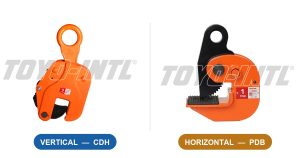
Use a vertical plate lifting clamp when the plate must be lifted, moved, or turned upright. Use a horizontal clamp when it must stay flat from pick-up to set-down. The two types cannot be swapped.
Key takeaways
- Vertical clamps lift, move, or turn a plate upright. Horizontal clamps keep a plate flat.
- A vertical clamp grips the plate edge with a spring-loaded lock. A horizontal clamp grips the plate body with a screw jaw.
- Read the WLL basis: CDH per clamp, PDB and LC per pair, PDQ per pair at 60°.
- Sling angle and plate hardness both reduce effective capacity. Declare both in the inquiry.
Quick comparison table
| Point | Vertical (CD, CDH) | Horizontal (PDB, PDQ, LC) |
| Orientation | Upright. | Flat throughout. |
| Mechanism | Spring-loaded lock on the plate edge. | Screw jaw on the plate body. |
| WLL basis | CDH: per clamp. | PDB and LC per pair. PDQ per pair at 60°. |
| Capacity | CDH 0.8–30 t per clamp. CD 0.8 t to CD 30. | PDB 800–16,000 kg per pair. PDQ 1–20 t. LC 1–3 t per pair. |
| Jaw opening | CDH 0–16 to 80–220 mm. | PDB 0–20 to 100–180 mm. LC narrow. |
| Turning 180° | CD only. | No. |
| Clamps per lift | One or two. | PDB four. PDQ four plus a lifting beam. |
| Sling angle | Per the datasheet. | PDB max 45° from vertical. PDQ rated at 60°. |
Note: These values describe representative TOYO-INTL models, not every clamp of that type. Check the specification sheet for the exact model.
Load direction: how each type carries the plate
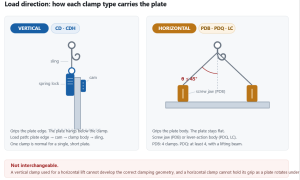
A vertical clamp grips the plate edge and the plate hangs below it. A horizontal clamp grips the plate body and the plate stays flat: the PDB screw jaw is set to the plate thickness, and the lever action of the body raises clamping force as sling tension rises. Swapped, neither clamp develops the correct geometry.
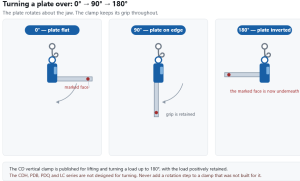
Turning a plate over: which clamp can rotate 180°
Only the CD clamp is published for lifting and turning a load up to 180° with the load positively retained. The CDH is published for vertical lifting and vertical transfer, not turning. The PDB, PDQ, and LC hold a plate flat and are not designed to rotate it.
The critical point is the vertical position. There the plate’s own weight stops pressing the jaw into the surface, so a clamp that relies on load-induced force can release mid-turn.
Working load limit: what the number is based on
The WLL is the maximum load a clamp is rated to carry under the published conditions. TOYO-INTL states it on three bases.
- CDH: per clamp, single plate, rated orientation.
- PDB: in kg per pair, from 800 kg (PDB 0.8) to 16,000 kg (PDB 16).
- LC: per pair — 1 t for LC1, 2 t for LC2, 3 t for LC3.
- PDQ: per pair at a 60° lift angle, at least four clamps in use.
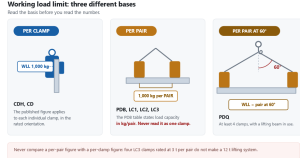
A per-pair figure can never be compared with a per-clamp figure.
Sling angle: how leg angle changes the required WLL
Leg tension equals the load share divided by the cosine of the angle from vertical. An 8,000 kg plate on four legs at 45° puts 2,820 kg on each leg (2,000 × 1.41). Four 2,000 kg clamps would be overloaded by 41 percent.
The angle factor is 1.00 at 0°, 1.15 at 30°, 1.41 at 45°, and 2.00 at 60° from vertical.
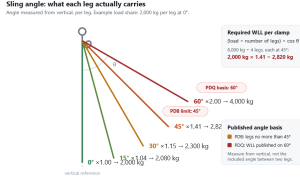
The PDB instruction limits the top angle to 45° from vertical, and the PDQ rating is published on a 60° basis. Give the supplier the angle used on site, not the catalogue drawing.
One clamp, a pair, or four clamps
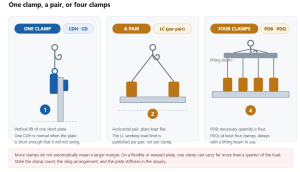
Vertical clamps may be used singly or in pairs. Horizontal clamps are used as a set: the PDB necessary quantity is four, and the PDQ requires at least four clamps plus a lifting beam. More clamps do not add margin unless the load is shared evenly.
Jaw opening and plate thickness
Measure the thickness at the clamping point, not on the drawing. Too small a jaw will not close over the plate; too large a jaw on thin plate closes too far and loses force. A wide jaw does not raise capacity, which the WLL sets. Below is Published CDH data. The WLL and weight figures are both per clamp.
| Model | WLL (t) | Jaw opening (mm) | Weight (kg per clamp) |
| CDH-B 0.8 | 0.8 | 0–16 | 2.8 |
| CDH-B 1 | 1 | 0–20 | 5 |
| CDH-B 2 | 2 | 0–30 | 6.2 |
| CDH-B 3.2 | 3.2 | 0–35 | 9.6 |
| CDH-B 5 | 5 | 0–50 | 15.8 |
| CDH-B 8 | 8 | 0–60 | 24 |
| CDH-B 10 | 10 | 0–90 | 31.2 |
| CDH-B 12 | 12 | 25–90 | 48 |
| CDH-B 16 | 16 | 60–125 | 80 |
| CDH-B 30 | 30 | 80–220 | 125 |
Plate condition: hardness, surface, and coating
Clamping depends on friction, so anything that reduces friction reduces effective capacity.
- The CDH instruction requires surface hardness below HRC30 / Brinell 300; the LC is published up to 37 RC (345 HB). Hardened plate can fall outside both.
- Oil, grease, moisture, frost. Wipe the clamping area dry.
- Scale, rust, paint, zinc. A flaking coating can shear away.
- Warping, burrs, deformation. Less contact area.
TOYO-INTL series to review
- CDH — standard vertical clamp. 0.8–30 t per clamp, jaw 0–16 to 80–220 mm, below HRC30 / Brinell 300.
- CD — vertical turning clamp, up to 180°. Models CD 0.8 to CD 30.
- PDB — standard horizontal clamp. 800–16,000 kg per pair, replaceable screw jaw. The PDB 6B is the wide-jaw variant: 0–130 mm at 6,000 kg per pair.
- PDQ — single or multiple plates. 1–20 t, lifting beam required.
- LC — light clamp for thin plate. 1, 2, and 3 t per pair, up to 37 RC (345 HB).
Below is published PDB data. Load capacity and weight are both stated per pair, as printed on the datasheet.
| Model | Jaw opening (mm) | Load capacity (kg per pair) | Weight (kg per pair) |
| PDB 0.8 | 0–20 | 800 | 2.65 |
| PDB 1 | 0–30 | 1,000 | 3.4 |
| PDB 1.6 | 0–30 | 1,600 | 4.6 |
| PDB 2 | 0–40 | 2,000 | 5.15 |
| PDB 3.2 | 0–45 | 3,200 | 5.85 |
| PDB 4 | 0–50 | 4,000 | 6.3 |
| PDB 5 | 0–55 | 5,000 | 6.9 |
| PDB 6 | 0–65 | 6,000 | 10.5 |
| PDB 6B | 0–130 | 6,000 | 22 |
| PDB 8 | 0–100 | 8,000 | 23.5 |
| PDB 10 | 0–125 | 10,000 | 32.5 |
| PDB 16 | 100–180 | 16,000 | 51 |
 |
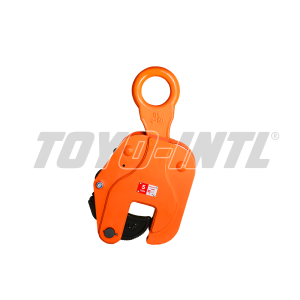 |
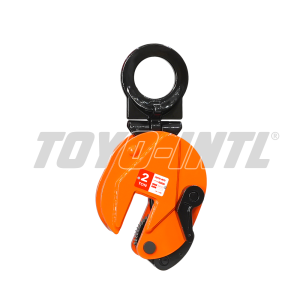
| CD | CDH |
F7 The vertical families (CD, CDH) covered in this guide
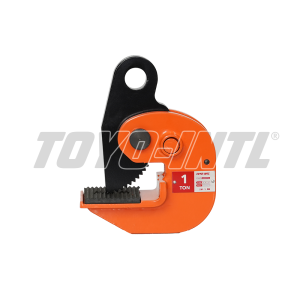 |
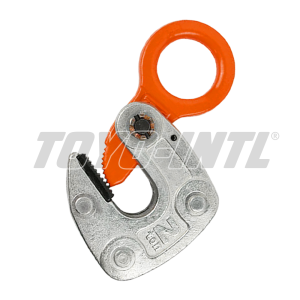 |
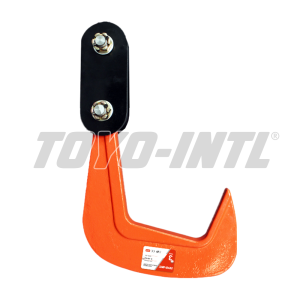 |
| PDB | LC | PDQ |
F8 The horizontal families (PDB, LC, PDQ) covered in this guide
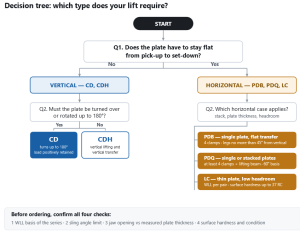
Decision tree: which type does your lift require?
Work through the questions in order. The first match decides the clamp family.
- Must the plate stay flat throughout? Yes: PDB, PDQ, or LC.
- Must it be turned over, up to 180°? Yes: the CD.
- Must it be lifted and moved upright? Yes: the CDH.
- Are several plates lifted at once? Yes: the PDQ, four clamps plus a beam.
- Is the plate thin, or is headroom tight? Yes: the LC.
- Then confirm the WLL basis, sling angle, jaw opening, and plate hardness.
What to include in a lifting clamp inquiry
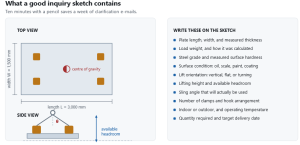
- Load shape, plate dimensions, and the weight of the heaviest piece.
- Steel grade, measured hardness, and surface condition at the clamp point.
- Lifting direction: upright, flat, turning, or a combination.
- Number of legs and the actual sling angle from vertical.
- Number of clamps, and whether a lifting beam is available.
- A sketch with clamp positions, sling legs, and headroom.
Send us your lifting application
Tell us the load shape and weight, the plate thickness and hardness, the lifting direction, and attach a lifting sketch. TOYO-INTL will confirm the model, the WLL basis, the sling angle limit, and the documentation.
Frequently asked questions
Can a vertical lifting clamp be used to lift a plate horizontally?
No. A vertical clamp on a horizontal lift cannot develop the correct geometry, and a horizontal clamp on a vertical lift loses grip as the plate rotates. Both risk a drop.
Can any plate lifting clamp turn a plate over?
No. Only the CD is published for lifting and turning up to 180° with the load retained. The CDH, PDB, PDQ, and LC cannot rotate a plate.
Which type of plate lifting clamp has a higher WLL?
The figure follows the model, not the type: 0.8–30 t per clamp for the CDH, 800–16,000 kg per pair for the PDB, and 1–3 t per pair for the LC.
How many clamps are needed for one lift?
Vertical clamps may be used singly or in pairs; the PDB necessary quantity is four, and the PDQ needs at least four with a beam. An uneven lift can overload one clamp.
What happens if the sling angle is too wide?
Leg tension rises as the legs move off vertical: 1.41 times the even share at 45°, and 2.00 times at 60°. The PDB limit is 45°.
Conclusion
The two types are not interchangeable: a vertical clamp lifts, moves, or turns a plate upright; a horizontal clamp keeps it flat. Send the load data, plate thickness and hardness, lifting direction, sling angle, and a sketch, and the model can be confirmed before ordering.
Sources: TOYO-INTL product pages for the CD, CDH, PDB, PDQ, and LC plate lifting clamps (toyointl.com, toyohoisting.com).