



Direct Answer
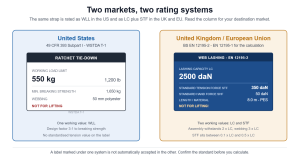
Use Working Load Limit (WLL) for tie-down calculations on US commercial motor vehicles under 49 CFR Part 393. In the UK and EU, use Lashing Capacity (LC) for direct lashing and Standard Tension Force (STF) for tie-down lashing under EN 12195-2. Breaking strength is a laboratory failure value, never a working rating. Confirm the value on the label of the exact configuration.
Core Conclusion
The correct rating follows the market and the lashing method: WLL governs US road cargo securement, LC and STF govern UK and EU road cargo securement, and breaking strength never replaces a working rating.
Standards guidance here is general industry guidance. TOYO-INTL statements appear only in the evidence-gap section below.
The Four Rating Terms: Definitions and Boundaries
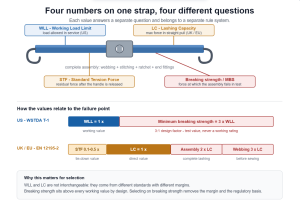
Ratchet strap labels carry four different numbers. Each number answers a different question.
| Term | What it measures | Where it applies |
| WLL | Load a component may carry | US road transport, 49 CFR 393 |
| LC | Maximum force in straight pull | UK and EU direct lashing |
| STF | Residual force after handle release | UK and EU tie-down lashing |
| Breaking strength | Force at which assembly fails | Test value in every market |
Table 1. Four rating terms.
WLL – Working Load Limit
WLL is the maximum load a cargo securement component may carry in normal service. The manufacturer assigns the value, and 49 CFR 393.5 defines the term.
WSTDA T-1 sets a 3:1 design factor for synthetic web tie-downs, so WLL is no more than one-third of the complete assembly’s minimum breaking strength. Boundary: WLL covers US road cargo securement, not lifting.
LC – Lashing Capacity
LC is the maximum force, in daN, that a web lashing is designed to sustain in straight pull. Under EN 12195-2, the complete lashing must withstand at least 2 x LC and the webbing before sewing at least 3 x LC.
Boundary: LC covers direct lashing in the UK and EU, designated BS EN 12195-2 in the UK, and is neither a lifting rating nor a tie-down value.
STF – Standard Tension Force
STF is the residual force in the strap after the ratchet handle is released. The value is produced with a standard hand force (SHF) of 500 N, printed as 50 daN, and EN 12195-1 places it between 0.1 x LC and 0.5 x LC.
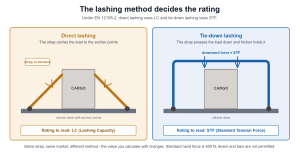
Boundary: STF covers frictional, or tie-down, lashing in the UK and EU. Levers and bars must not be used to raise tension.
Breaking Strength (BF or MBS)
Breaking strength is the force at which the complete assembly fails in a test to destruction, pulling webbing, stitching, ratchet, and end fittings together. US documents call it minimum breaking strength, or MBS. It is a test result, not a working rating.
Boundary:It is a test value in every market, never a working rating and never a selection value.
Step by Step: Which Rating Applies to Your Case
Step 1. Identify the jurisdiction. US road transport follows FMCSA rules in 49 CFR Part 393; UK and EU road transport follows EN 12195.
Step 2. Identify the lashing method. Direct lashing carries load through the strap to anchor points; tie-down lashing holds the load by friction.
Step 3. Read the label. It shows the rating system, the values, and the standard. Do not calculate with an unlabelled strap.
Step 4. Apply the market rule. The US requires aggregate WLL of at least one-half the cargo weight (49 CFR 393.106(d)). The UK and EU calculate strap count per EN 12195-1.
Step 5. Request a label sample of the exact configuration, the test report, and the standard.
Worked Examples (Illustrative Only)
Both examples are illustrations. A real calculation needs the label values, the lashing geometry, and the current standard.
Example A – United States, WLL route
A 4,000 kg load travels on a US commercial motor vehicle. Required aggregate WLL is at least 2,000 kg, one-half of the cargo weight, under 49 CFR 393.106(d). Four tie-downs labelled WLL 550 kg give 2,200 kg. The count must also satisfy 49 CFR 393.110 and any commodity-specific rule.
Example B – European Union, STF route
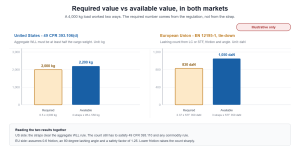
A 4,000 kg load travels in the EU under tie-down lashing, so the weight force is 3,924 daN. With an anti-slip mat (friction 0.6), an 80-degree lashing angle, a safety factor of 1.25, and straps labelled STF 350 daN, EN 12195-1 gives n = 1.25 x 3,924 x (0.8 – 0.6) / (2 x 350 x 0.6 x 0.985) = 2.37, so three straps are needed.
United States: Where WLL Applies
49 CFR 393.106(d) sets the core US rule: aggregate tie-down WLL must be at least one-half of the cargo weight.
49 CFR 393.102(a) sets two levels. Breaking strength must not be exceeded at 0.8 g forward, 0.5 g rearward, and 0.5 g lateral. WLL must not be exceeded at 0.435 g forward, 0.5 g rearward, and 0.25 g lateral. Section 393.102(b) requires downward force of at least 20 percent of cargo weight for uncovered loads.
Boundaries: these rules cover cargo securement on US commercial motor vehicles on public roads, not lifting, and states and commodity sections 393.104 to 393.136 can add requirements.
United Kingdom and European Union: Where LC and STF Apply
EN 12195-2 covers web lashings of man-made fibres with hand-driven tensioning devices on road vehicles in the UK and EU. LC is the value for direct lashing, and STF the value for tie-down lashing. Standard hand force is 500 N, printed as 50 daN. Levers and bars must not be used.
The label must show LC, STF where relevant, SHF, lengths, “Not for lifting!”, material, manufacturer, traceability code, standard, year of manufacture, and elongation at LC.
Boundaries: strap count and arrangement follow EN 12195-1. An EN 12195-2 strap is not automatically compliant with US rules, and a WSTDA T-1 label is not automatically accepted in the UK or EU.
Why Breaking Strength Is Not a Universal Selection Value
Breaking strength describes the failure point of the complete assembly, and working ratings sit below it by design.
The two systems use different margins. WLL is at most one-third of the complete assembly’s minimum breaking strength under WSTDA T-1. The complete lashing must withstand 2 x LC and the webbing 3 x LC under EN 12195-2.
Selecting by breaking strength removes the margin and the regulatory basis. A strap with high breaking strength can still carry a low WLL or LC, because stitching, end fittings, or the ratchet limits the assembly.
Label Reading Table
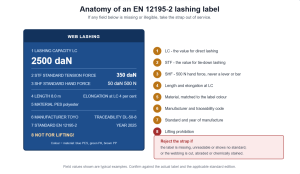
Read the column for the destination market. A label normally shows one rating system. Where US and EU values both appear, confirm which standard each value refers to.
| Field | EN 12195-2 label | US label (WSTDA T-1) |
| Working rating | LC in daN, direct lashing | WLL in lb or kg |
| Tension value | STF in daN, tie-down lashing | Not standardised |
| Hand force | SHF 50 daN (500 N) | Not standardised |
| Warning | “Not for lifting!” | Lifting prohibition |
| Material and colour | Blue PES, green PA, brown PP | Webbing type stated |
| Standard | EN 12195-2 | WSTDA T-1 or manufacturer standard |
Table 2. Label fields to check.
Component Limits vs Complete-System Ratings
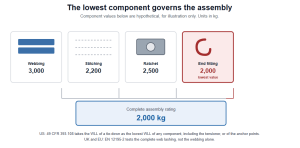
The rating belongs to the complete assembly, not to the webbing alone. In the US, 49 CFR 393.108 takes the lowest WLL of any component or anchor point, and WSTDA T-1 bases WLL on the complete assembly. In the UK and EU, EN 12195-2 tests the complete web lashing: 2 x LC for the assembly, 3 x LC for the webbing before sewing, plus a handle test on the tensioning device.
Two straps with identical webbing can carry different ratings when end fittings or ratchets differ.
TOYO-INTL Published Data and the Evidence Gap
This section reports TOYO-INTL published information only; the guidance above applies to every manufacturer. Any TOYO-INTL claim must be confirmed against the label, the test report, and the standard. The catalogue, edition 2024-09-20, lists the DL series under “Working Load (kg)”.
| Model | Working Load | Working length | Webbing width |
| DL010 | 1,000 kg (1 T) | 4-8 m | 25 mm (1 in) |
| DL015 | 1,500 kg (1.5 T) | 4-8 m | 25 mm (1 in) |
| DL020 | 2,000 kg (2 T) | 4-8 m | 38 mm / 50 mm |
| DL030 | 3,000 kg (3 T) | 4-12 m | 38 mm / 50 mm |
| DL040 | 3,000 kg (3 T) | 4-12 m | 50 mm (2 in) |
| DL050 | 5,000 kg (5 T) | 4-12 m | 50 mm (2 in) |
| DL080 | 8,000 kg (8 T) | 4-12 m | 75 mm (3 in) |
Table 3. DL series, catalogue edition 2024-09-20.
The catalogue states no standard, design factor, LC, or STF, and does not say whether the value covers direct or tie-down lashing. The DL page states “5 times safety factor” without naming a standard or showing a test report.
Why it matters: “Working Load” is not a standardised term, and the correct value depends on market and method, so the published figure cannot enter a calculation without a label sample and test report.
Ask TOYO-INTL for a label photo of the exact model, width, length, and end fitting; the standard and edition; the design factor and assembly breaking force from a test report; LC or STF where EN 12195-2 applies; and written confirmation of the lashing method.
Related guide: the TOYO-INTL ratchet tie-down guide covers threading and release.
TOYO-INTL Model Product Families
The 2024-09-20 catalogue also covers lifting slings. They matter here for one reason: lifting slings and lashing straps are rated under different systems, and mixing the two is a common sourcing error. Four families appear in the pages reproduced below.
DL – Cargo Lashing Series, the Straps This Article Is About
The DL series is the ratchet lashing line this article evaluates: DL010 to DL100, Working Load 1,000 to 10,000 kg, working lengths of 4-8 m or 4-12 m, and webbing widths of 25 to 100 mm (Table 3). The catalogue page adds construction claims: polyester or polypropylene yarns, a three-year UV rating for the polypropylene webbing, automated stitching to reduce labour error, double J-hooks for grip, and a label that identifies the product. A retractable ratchet series in sizes 50 and 25 is also listed. The evidence gap set out above applies unchanged: the page names no standard, no design factor, and no LC or STF.
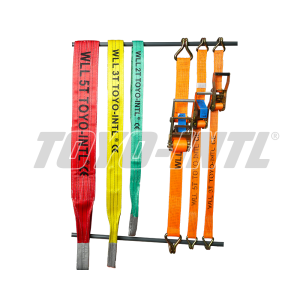
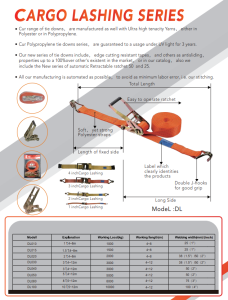
F7. DL cargo lashing series, construction callouts and specification table, catalogue edition 2024-09-20.
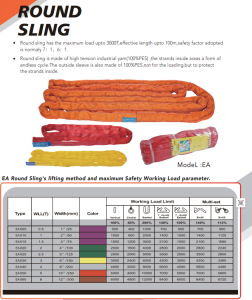
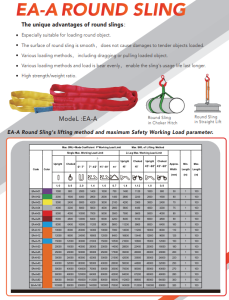
EA and EA-A – Round Slings, Lifting Products
Round slings are lifting products, not lashings. The catalogue describes an endless core of 100% polyester yarn inside a sleeve that protects the strands but does not carry load, and publishes WLL by colour: 0.5 t for EA005 up to 6 t for EA060 in the EA table, and up to 100,000 kg in the EA-A table. Mode coefficients follow the lifting convention: vertical 1.0, choke 0.8, basket 2.0, with reduced values as the basket angle opens past 45 degrees. The page states a safety factor “normally 7:1, 6:1” and a maximum load “up to 3000T”; the 3000T figure conflicts with the tables and must be confirmed before any use.
EB – Webbing Sling, Lifting Products
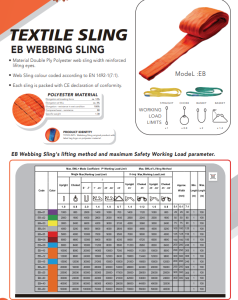
The EB webbing sling is double-ply polyester with reinforced eyes, colour coded to EN 1492-1, and shipped with a CE declaration of conformity. Published WLL runs from 1,000 kg (EB-01) to 10,000 kg (EB-15) in straight pull, with the same mode coefficients. This is the one catalogue page that names a standard, and the contrast is the point: the lifting pages publish colour codes, coefficients, and a CE document, while the DL lashing page publishes none of these.
The Split Buyers Must Respect
A lifting sling’s WLL belongs to lifting. A ratchet lashing is rated WLL in the US and LC plus STF in the UK and EU. Do not order a round sling or webbing sling as lashing hardware, or a ratchet strap as lifting gear, without written confirmation from TOYO-INTL of the rating system, the standard, and the intended use for the exact model.
Common Mistakes
- Selecting by breaking strength instead of WLL or LC and STF.
- Using WLL for UK and EU cargo, where LC and STF apply.
- Using LC where STF is required; tie-down lashing needs an STF value.
- Assuming width decides capacity, when the label decides.
- Mixing rating systems on one load instead of confirming every strap against one standard.
- Using unlabelled or damaged straps, which must be taken out of service.
Buyer Checklist and Information Form
Collect these fields before ordering; each field can change the rating or the document.
- Target market and jurisdiction: US, UK, EU, or other.
- Lashing method: direct or tie-down (frictional).
- Cargo weight and dimensions: kg or lb, with contact area.
- Number and length of straps: quantity and working lengths.
- Anchor points: type, rated capacity, position.
- Required standard: 49 CFR 393 and WSTDA T-1, or EN 12195-2.
- Rating to use: WLL (US) or LC and STF (UK and EU).
- Label sample: photo or sample of the exact configuration.
- Test report: breaking force, design factor, traceability.
Frequently Asked Questions
Which rating should I use for my target market and lashing method?
Use WLL under 49 CFR Part 393 in the US. Use LC for direct lashing and STF for tie-down lashing under EN 12195-2 in the UK and EU.
Is WLL the same as LC?
No. WLL is the US working load, no more than one-third of the complete-assembly breaking strength. LC is the EN 12195-2 straight-pull rating: the complete lashing must withstand at least 2 × LC in test, and the webbing 3 × LC.
Can I use breaking strength if I apply my own safety factor?
No. The manufacturer assigns the working rating and marks it on the label, so a self-designed factor has no standing.
Are US and UK or EU rules interchangeable?
No. 49 CFR Part 393 applies in the US and EN 12195-2 applies in the UK and EU. Compliance in one jurisdiction does not mean the same in the other.
What documents should I request from TOYO-INTL before ordering?
Request a label sample of the exact configuration, the standard and its edition, a test report with the assembly breaking force and design factor, and LC or STF where EN 12195-2 applies.
Sources and Last Review Date
- 49 CFR 393.102, 393.106, 393.108, 393.5 (US FMCSA).
- WSTDA T-1 – synthetic web tie downs.
- BS EN 12195-2 – web lashing made from man-made fibres.
- EN 12195-1 – calculation of securing forces.
- TOYO-INTL Company Catalogue (2024-09-20), DL product page, tie-down guide (2025-05-16).
All sources accessed 2026-09-17.
Last review date: 2026-09-17.
Conclusion and Next Step
The rating depends on where the cargo travels and how it is lashed: WLL governs the US, LC and STF govern the UK and EU, and breaking strength never replaces a working rating.
Before ordering, obtain a label sample, a test report, and the standard for the exact configuration, and ask TOYO-INTL to confirm the rating and lashing method in writing.