


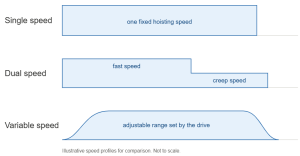
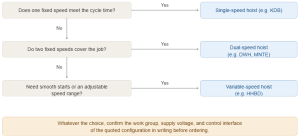
No single arrangement wins for all jobs. Choose a single-speed electric hoist when one cycle time is acceptable and purchase cost matters most. Choose a dual-speed electric hoist when a fast main speed plus a creep speed is needed for load positioning. Choose a variable-speed (inverter-controlled) electric hoist when smooth starts, selectable speeds, or frequent precise placement justify added control equipment. The correct answer depends on load, cycle count, positioning need, and site power.
Key Takeaways
- A single-speed hoist publishes one lifting speed per configuration, for example the TOYO-INTL KDB main table lists one value for each capacity row.[1]
- A dual-speed hoist publishes two discrete speeds, usually as a fast/creep pair, for example the TOYO-INTL DWH table lists paired lifting speeds such as 0.8/5 and 1.6/10 m/min.[2]
- A variable-speed hoist uses inverter (frequency-conversion) control, which the TOYO-INTL HHBD page and the DWH control-box description publish as listed features.[2,3]
- Published speed figures describe specific TOYO-INTL models and configurations. Those figures are not universal limits for any speed category.
- The RFQ should state the required main speed, creep speed, and positioning task, not only the load weight.
Quick Comparison Table
| Comparison point | Single-speed hoist | Dual-speed hoist | Variable-speed (inverter) hoist |
| Speed steps | One lifting speed per configuration | Two discrete speeds (fast and creep) | A control range set by the drive |
| How the speed is produced | Direct single-speed motor drive | Two motor windings, two motors, or an added low-speed step | Frequency converter varies motor speed |
| Published TOYO-INTL speed example | KDB: 1.8–6.8 m/min across listed configurations | DWH: paired speeds from 0.66/4 to 1.6/10 m/min | HHBD: 2.2–8.8 m/min across listed configurations, with published inverter advantages |
| Positioning behavior | Operator controls stopping only | Creep speed assists hook alignment before landing | Smooth start and stop; creep zone can be adjusted within drive limits |
| Drive complexity | Lowest motor and control count | Extra speed circuit or motor | Adds frequency-conversion control equipment |
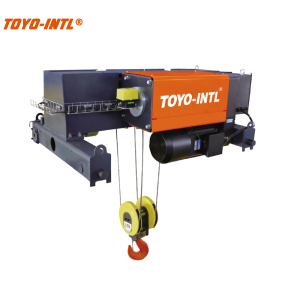
| Representative models on TOYO-INTL pages | KDB, CD1, SH | MNTE, PA, DWH | HHBD; DWH page lists a frequency-conversion control box |
Note: This table compares representative published models, not every product in each category. Because the models differ in capacity, lift height, work class, and supply voltage, this article does not name a universal winner among the three arrangements. Speed categories in this article refer to hoisting speed. Trolley travel speed is specified separately and may differ within the same model.
How Does Each Arrangement Produce Speed?
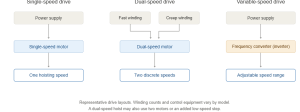
A single-speed electric hoist runs its hoisting motor at one fixed speed in each direction. The published specification table shows one lifting-speed value for each model configuration. This arrangement uses the fewest electrical components in the hoisting drive.
A dual-speed electric hoist offers two selectable lifting speeds. The fast speed handles normal travel, and the lower creep speed supports hook approach and load landing. TOYO-INTL publishes dual-speed values as pairs, for example 10/5 m/min on the PA category listing and 0.66/4 to 1.6/10 m/min on the DWH table.[4,2]
A variable-speed electric hoist changes motor speed through frequency-conversion (inverter) control. The TOYO-INTL HHBD page states the inverter advantages as smooth starting, reduced motor heat and noise, and extended motor life.[3] The DWH product description also lists a frequency-conversion control box as a product feature.[2] The adjustable speed range and control method must be confirmed for the selected model.
What Lifting Speeds Do Published TOYO-INTL Models Show?
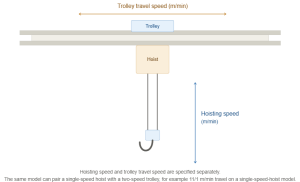
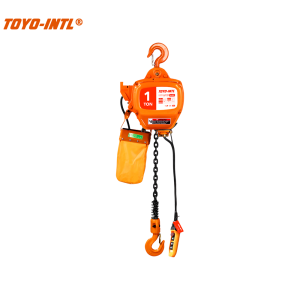
The KDB Electric Chain Hoist category card lists capacity 0.5–10 t, lifting height 4 m, and lifting speed 1.8–6.8 m/min.[4] The KDB detail table shows one lifting-speed value per configuration, such as 6.8 m/min at 1T and 1.8 m/min at 7.5T, and lists trolley travel speed as 11/1 or 21/1 m/min.[1]
The DWH Double Girder Electric Hoist table lists paired lifting speeds from 0.66/4 m/min up to 1.6/10 m/min, with a traveling speed of 5/20 m/min and work groups from 1Am/M4 to 4m/M7 depending on configuration.[2]
The MNTE Electric Chain Hoist card lists capacity 0.3–0.5 t and paired lifting speeds from 1.5/4.5 to 3/9 m/min.[4] The HHBD Electric Hoist card lists capacity 1–10 t, lifting height 3/9 m, and lifting speed 2.2–8.8 m/min across listed configurations.[4]
These figures differ by model, capacity, and chain-fall or rope-fall arrangement. A buyer should read each speed value together with the exact configuration row, not as a category-wide limit.
How Does Each Arrangement Handle Positioning and Load Shock?
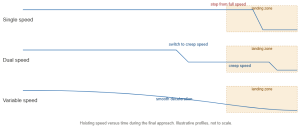
Positioning quality improves when the final approach happens at a lower speed. A single-speed hoist reaches the landing zone at full speed, and the operator depends on brake timing and short button pulses. A dual-speed hoist switches to the creep speed before the final approach, which reduces the distance needed for the last correction.
The HHBD page states that the dual-speed setting with inverter control is mainly used for precise control of the lifting height and accurate positioning of lifted objects.[3] The same page states that inverter starting is smooth, with less motor heat and noise.[3] Smooth-start claims apply to the listed models and should be verified against the selected configuration.
Fragile loads, molds, and machined parts reward slower final approach. Loose bulk tools and general workshop transfer usually do not require a creep speed at all.
What About Complexity, Maintenance, and Cost?
Single-speed drives have the fewest hoisting-speed components, so they are the simplest arrangement to specify. Dual-speed drives add a second speed circuit or a second motor, which raises the motor and control count. Variable-speed arrangements add a frequency converter, which increases the electrical content of the system.
Maintenance cost follows the same order: fewer components usually means fewer electrical items to inspect. The TOYO-INTL DWH description lists an intelligent safety monitor with running-time and overload-time recording and a brake-wear alarm, features that support planned maintenance on configured models.[2] Purchase price, energy behavior, and service requirements should be confirmed model by model in the RFQ stage.
How Do Duty Class and Operating Frequency Interact With Speed Choice?
Frequent starts at the high end of a speed range increase the duty demanded of the motor and brake. The DWH table publishes work groups from 1Am/M4 to 4m/M7 across its speed and capacity configurations, which shows that the selected configuration changes the duty rating.[2]
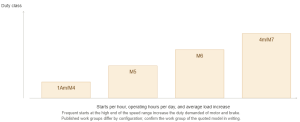
A dual-speed or inverter arrangement can shorten idle travel time while keeping creep-speed cycles gentle. Buyers should supply lifts per hour, operating hours per day, and average load before asking for a duty-class recommendation. The supplier should then confirm the work group of the proposed configuration in writing.
Which Installation, Power, and Control Details Change With the Speed Arrangement?
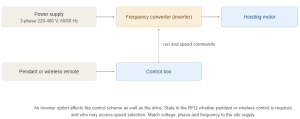
The KDB main table publishes three-phase 220–480 V, 50/60 Hz input across its listed configurations.[1] Power data differs across TOYO-INTL series, so the voltage, phase, and frequency of the chosen model must be matched to the site supply.
An inverter option affects the control scheme as well as the drive. The RFQ should state whether pendant control, wireless control, or another interface is required, and whether the creep speed or the speed range needs operator access. Runway items such as beam type, flange width, headroom, and curve radius apply to all three arrangements and should be supplied with the inquiry.
When Should You Choose a Single-Speed Hoist?
Choose a single-speed hoist when the cycle time at one lifting speed already meets production needs. Choose a single-speed hoist for infrequent maintenance lifts, loading docks, and general workshop transfer. Choose a single-speed hoist when the budget must stay on capacity, height, and safety devices instead of extra drives.
When Should You Choose a Dual-Speed Hoist?
Choose a dual-speed hoist when loads must align with molds, fixtures, or machine tables before landing. Choose a dual-speed hoist when long vertical travel is common and the fast speed saves cycle time on every lift. Choose a dual-speed hoist when two fixed speeds cover the job and no continuously adjustable range is required.
When Should You Choose a Variable-Speed (Inverter) Hoist?
Choose a variable-speed hoist when smooth starting and stopping protect sensitive loads or the structure. Choose a variable-speed hoist when process speeds differ by shift, material, or operator and one fixed pair of speeds cannot cover them. Choose a variable-speed hoist when published model data, such as the HHBD inverter advantages, matches a documented need in the application.[3]
What Information Should the RFQ Include Before Any Recommendation?
Do not accept a recommendation until the inquiry contains the following items:
- Maximum load and typical load
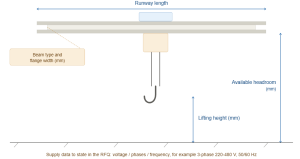
- Required lifting height and available headroom
- Required main lifting speed and creep or inching speed
- Required positioning accuracy in millimeters, if precision matters
- Lifts or starts per hour and operating hours per day
- Fixed suspension, push trolley, or powered trolley, with beam type, flange width, runway length, and curve data
- Available voltage, number of phases, and frequency
- Control preference: pendant, wireless, or other, plus who may access speed selection
- Operating environment: indoor, outdoor, dusty, humid, corrosive, or hot
- Destination country or region
- Quantity and required technical documents, such as certificates, manuals, and wiring diagrams
Frequently Asked Questions
Is a dual-speed hoist always better than a single-speed hoist?
No. A dual-speed hoist adds a creep speed that helps positioning, but the benefit depends on the task. Many applications complete every cycle correctly at one published speed, such as the single lifting-speed values shown per KDB configuration row.[1]
What do the paired numbers in a speed column mean?
On the pages checked for this article, paired numbers show two discrete speeds, written as low/high or high/low depending on the table. For example, the DWH table lists pairs such as 0.8/5 and 1.6/10 m/min, and the traveling-speed column lists 5/20 m/min.[2] Confirm the notation for the selected model before ordering.
Does variable speed mean the hook can run at any speed?
A frequency converter provides an adjustable range rather than fixed steps, but the usable range belongs to the specific drive and motor configuration. The HHBD and DWH pages publish inverter features without publishing one universal speed range for every configuration.[2,3] Ask the supplier for the adjustable range of the quoted model.
Can an existing single-speed hoist be converted to inverter control?
The published TOYO-INTL pages do not state a retrofit program for existing units. Send the model nameplate data and the site supply to the supplier and ask what conversion, if any, is supported for that model.
Does TOYO-INTL offer all three speed arrangements?
The checked pages show single lifting-speed values per configuration on the KDB table, paired speeds on the DWH and MNTE tables, and inverter advantages on the HHBD page.[4,1,2,3] The exact arrangement must be confirmed for the selected model and configuration.
Conclusion
Single-speed, dual-speed, and variable-speed electric hoists solve different parts of the same job. A single-speed hoist is sufficient when one published speed meets the cycle time. A dual-speed hoist pays off when a creep speed shortens positioning work. A variable-speed hoist adds value when smooth starts or an adjustable range are documented needs. Because the published models differ in capacity, height, work class, and supply, this comparison names no universal winner. The next step is a complete application description and an RFQ that states the required speeds, and then a written confirmation of the model, configuration, limits, and documents before ordering.
Sources
[1] TOYO-INTL, “TOYO-INTL KDB Electric Chain Hoist” product page and specification tables, toyointl.com. Accessed September 16, 2026.
[2] TOYO-INTL, “TOYO-INTL DWH Double Girder Electric Hoist” product page and specification table, toyointl.com. Accessed September 16, 2026.
[3] TOYO-INTL, “TOYO-INTL Electric Chain Hoist HHBD Model” product page (inverter and dual-speed advantages), toyohoisting.com. Accessed September 16, 2026.
[4] TOYO-INTL, “Electric Hoists” product category listings (KDB, HHBT, DWH, SWH, MNTE, TCS, PA, HHBD, HHBB, CD1, SH, PBS cards), toyointl.com. Accessed September 16, 2026.