


Match the lifting tool to the load shape before comparing anything else. CD and CDH grip vertical steel plate, PDB, PDQ, and LC carry horizontal plate, TPH grips pipe, JG clamps a beam flange, CDL and CDLB lift drums, and PML and PML-A hold ferromagnetic steel with a permanent magnet.
This list follows load shape, not a best-to-worst ranking. Each entry separates what TOYO-INTL’s pages state as of 2026-09-28 from what a buyer should confirm with the manufacturer.
Six Load Shapes at a Glance
Use the table below to build a shortlist, then verify the selected model against its own specification table.
| Load shape | Model family | Published capacity (official pages) | Application (as published) |
| Vertical steel plate | CD / CDH | CD 0.8-30 t per clamp; CDH 0.8-30 t per clamp | Vertical steel-plate lifting; CD also 180° turning |
| Horizontal steel plate | PDB / PDQ / LC | PDB 0.8-16 t per pair; PDQ 1-20 t per pair at 60°; LC 1-3 t per pair | Horizontal plate lifting and transport; single or multiple plates |
| Pipe | TPH | 1.5-18 t per pair | Horizontal steel and concrete pipe lifting |
| Beam connection | JG | 1-10 t | Beam clamping / hoisting |
| Drum | CDL / CDLB | 1,000 kg | Drum lifter / beam-flange rigging point |
| Ferromagnetic plate / round steel | PML / PML-A | PML 100-5,000 kg; PML-A plate 100-2,000 kg, round 50-1,000 kg | Lifting ferrous plate and round/columnar workpieces |
Note: the capacities above are family ranges as published on 2026-09-28, not guarantees for any single model. Always check the exact model’s specification table before you order.
1. Vertical Steel Plate: CD and CDH
When to shortlist CD and CDH
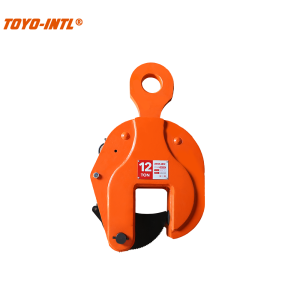
Put CD and CDH on the shortlist for vertical lifting of steel plates, steel structures, ship sections, or pile-sheet extraction. Choose CD when the load must also turn through 180°; choose CDH for straight vertical lifting only.
What the published data says
The category page lists CD at 0.8-30 t per clamp with jaw openings from 0-15 to 60-220 mm, and CDH at 0.8-30 t per clamp with jaw openings from 0-16 to 80-220 mm. The CDH page adds a forged lifting ring and a spring-loaded tightening lock that provides positive initial clamping force, plus a safety mechanism against slipping. The CD page adds a safety latch with double locking in the open and closed positions and a guaranteed pre-load on the material.
What to confirm before ordering
- Plate thickness and edge condition against the chosen model’s jaw-opening range.
- Turning required (CD) or straight vertical lifting only (CDH).
- The selected model’s own specification table, because family ranges summarize many models.
- Applicable standard, certificates, and proof-load records for the destination.
2. Horizontal Steel Plate: PDB, PDQ, and LC
When to shortlist PDB, PDQ, and LC
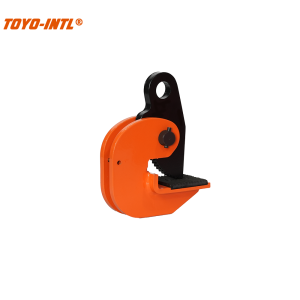
These families fit when the plate is lifted or transported in a horizontal position. Lead with PDQ when single or multiple plates may be handled together; PDB is the standard horizontal plate clamp, and LC the lighter clamp for smaller paired capacities.
What the published data says
The category page lists PDB at 0.8-16 t per pair with jaw openings from 0-20 to 100-180 mm, PDQ at 1-20 t with jaw openings from 0-50 to 0-250 mm for single or multiple plates, and LC at 1-3 t per pair. The PDB page adds handling of steel plates, construction, and profiled bars in a horizontal position, with a changeable screw jaw and a safety button. TOYO-INTL’s technical pages state that the PDQ rating assumes use in pairs at a 60° lift angle, with at least four clamps per lifting operation. The 60° lift angle is the included angle between the two sling legs.
What to confirm before ordering
- One plate at a time or several together; that decides which family leads.
- Plate thickness against the jaw opening, the number of clamps, and the sling angle.
- Load sharing: the per-pair WLL convention, the 60° lift angle for PDQ, and the four-clamp minimum.
3. Pipe: TPH
When to shortlist TPH
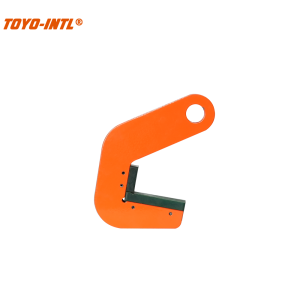
TPH is the family for horizontal lifting and transport of steel or concrete pipes. TOYO-INTL delivers and rates TPH per pair, with a protective surface intended to reduce marking.
What the published data says
The category page lists TPH at 1.5-18 t per pair with a jaw opening of 40-70 mm for horizontal steel and concrete pipe lifting. The product page describes a compact shape, low own weight with high lifting capacity, and a plastic cover that is easy to change.
What to confirm before ordering
- Pipe outer diameter against the jaw opening; length and weight against the number of pairs.
- Steel or concrete pipe, and whether the protective surface meets the requirement.
- Sling arrangement, and whether spare plastic covers are needed.
4. Beam Connection: JG
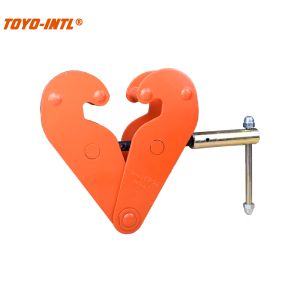
JG is the family to review when the operation needs a rigging point on an I-beam flange, for example to hang a hoist or chain block or to suspend a load from a beam.
What the published data says
The category page lists JG at 1-10 t with a jaw range of 75-320 mm I-beam width for beam clamping and hoisting. An SS304 stainless steel version (listed as a new product) covers the same range where corrosion resistance matters.
What to confirm before ordering
- Beam flange width, shape, taper, and surface condition against the jaw range.
- Standard steel or SS304, according to the environment.
- Load direction, the intended hoist or chain block, and any applicable beam-clamp standard.
5. Steel Drums: CDL and CDLB
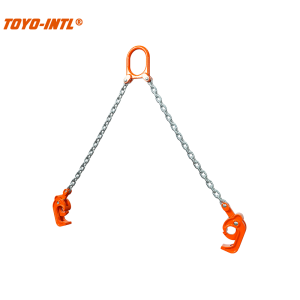
When to shortlist CDL and CDLB
CDL and CDLB fit when the load is steel drums or barrels; the same products are also positioned as a beam-flange rigging point.
What the published data says
The category page lists both families at 1,000 kg with the application “drum lifter / beam-flange rigging point.” Listings describe a CDL long-claw drum clamp with lifting chain and wide adjustment range, and a CDLB drum lifter with a 6 x 18 mm chain and a 500 mm lifting chain in some published data.
What to confirm before ordering
- Drum type and size: steel or plastic, rim and lid condition.
- Single or double lifting arrangement.
- Chain grade and length, and drum lifter versus beam-flange use.
6. Ferromagnetic Steel: PML and PML-A Magnet Lifters
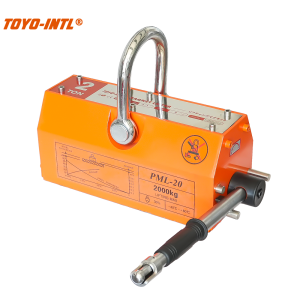
When to shortlist PML and PML-A
PML and PML-A fit when the load is ferromagnetic steel and a mechanical clamp does not suit the job; published applications include factory, dock, warehouse, and transport operations. Ferromagnetic means the material is attracted to a magnet, the precondition for magnetic lifting.
What the published data says
The category page lists PML at 100-5,000 kg with a maximum pull force of 300-15,000 kg for plate and round steel, and PML-A at 100-2,000 kg for plate and 50-1,000 kg for round steel, with a pull force of 3.5 times the rated capacity. The PML page publishes a full table from PML-100 to PML-5000 with rated lifting weight, pulling power, and net weight.
What to confirm before ordering
- Plate thickness, material grade, and surface condition, because magnetic holding depends on all three.
- Flat or round workpiece; plan with the working load limit, not the pull force.
- The safety factor and operating instructions for the application.
How to Choose Among the Six Load Shapes
The load shape decides the family before any capacity number matters. A vertical clamp on a horizontal lift cannot develop the correct geometry, and a horizontal clamp loses grip when the plate rotates. Fix the lifting direction first, then compare models inside the matching family.
Next, set the capacity basis. CD and CDH publish WLL per clamp, PDB, TPH, and LC per pair, and PDQ per pair at a 60° lift angle. Reading a per-clamp figure as per-pair, or the reverse, doubles or halves the planned load. Confirm the number of clamps and the sling angle at the same time.
Finally, check the surface and the environment. Plate hardness, coatings, and edge condition affect clamping; corrosion exposure may point to the SS304 beam clamp, and a coated pipe to the TPH plastic surface. Then list the destination documents with the RFQ checklist below.
A Practical Shortlisting Sequence
- Identify the load shape and lifting direction: vertical plate, horizontal plate, pipe, beam flange, drum, or ferrous plate and round steel.
- Define the maximum load and key dimensions: plate thickness, pipe outer diameter, beam flange width, or drum size.
- Match the model family to the published WLL and jaw or opening range.
- Decide the number of clamps and the sling angle. For per-pair families (PDB, TPH, LC), confirm load sharing; PDQ is stated for a 60° lift angle with at least four clamps.
- Check surface protection and environment: corrosion may point to the SS304 beam clamp, a coated pipe to the TPH plastic surface.
- Confirm certification, destination requirements, and documents with TOYO-INTL before ordering.
RFQ (Request for Quotation) Checklist for TOYO-INTL
Ask TOYO-INTL to confirm the selected model, its WLL, jaw opening, and limitations, and provide:
- Load shape, maximum weight, and dimensions (thickness, outer diameter, flange width, or drum type).
- Lifting mode: single or multiple plate, turning required, sling angle.
- Number of clamps or lifters and the sling arrangement.
- Operating environment: indoor or outdoor, corrosion, dust, temperature.
- Destination documents: manual, test records, declarations, certificates.
- A request for the model’s capacity and jaw-opening table with the quotation.
Frequently Asked Questions
Which TOYO-INTL lifting clamp is best?
No single family is best. Each of the six families publishes capacity, jaw, and application data for a different load shape, so build the shortlist from the load shape first.
Is the order in this article a best-to-worst ranking?
No. The six sections follow load shapes, not a product test or quality ranking, and no scores are assigned.
Vertical or horizontal plate: which model family?
Vertical lifting calls for CD or CDH; horizontal lifting and transport call for PDB, PDQ, or LC. Confirm the turning requirement and the single-versus-multiple plate mode before ordering.
Can a permanent magnet lifter be used on any steel?
No. Magnetic holding depends on the material being ferromagnetic, on plate thickness, and on surface condition. Plan with the published working load limit, not the magnetic force.
Do the WLL figures apply per clamp or per pair?
CD and CDH are rated per clamp; PDB, TPH, and LC per pair; PDQ per pair at a 60° lift angle with at least four clamps. Confirm the number of clamps and the sling angle before lifting.
Do I need to confirm certifications?
TOYO-INTL pages state CE marking and a three-year warranty. Requirements vary by destination and application, so confirm the documents before ordering.
Conclusion
CD and CDH cover vertical plate, PDB, PDQ, and LC cover horizontal plate, TPH covers pipe, JG covers beam flanges, CDL and CDLB cover drums, and PML and PML-A cover ferromagnetic steel. Together the six load shapes map the published TOYO-INTL clamp and lifter families.
Use the product pages to build a shortlist, then send TOYO-INTL the load shape, maximum weight, key dimensions, number of clamps, sling angle, and destination documents with the RFQ checklist above for final confirmation.
Sources, Reviewer, and Last Review Date
Sources (accessed 2026-09-28):
| Source (official TOYO-INTL page) | Used for |
| Lifting Clamp & Magnetic Lifter category page | WLL, jaw openings, and applications for all six families |
| CDH Lifting Clamp | CDH capacity, jaw range, forged ring, spring-loaded lock |
| CD Lifting Clamp | CD capacity, jaw range, 180° turning, safety latch |
| PDB Lifting Clamp | Horizontal application, screw jaw, safety button |
| TPH Lifting Clamp | Pipe capacity, plastic surface, per-pair delivery |
| JG Beam Clamp | Beam clamp capacity and jaw range |
| PML Permanent Magnet Lifter | Full PML table (rated weight, pull force, net weight) |
| PML-A Permanent Magnet Lifter | Plate/round capacities, 3.5 times pull-force factor |
Boundary note: figures in this article are taken from TOYO-INTL’s published pages as of the access date and should be re-verified before publication. No capacity, quality, or performance ranking is implied.