


An electric hoist’s duty information must be checked on the exact model and configuration. TOYO-INTL’s current product pages use several published labels, including M3, M4, M5, M4/30% ED, and paired FEM/ISO work groups. These labels should not be treated as interchangeable without confirming the applicable classification system and product documentation.
Duty selection also requires more than rated capacity. Buyers should describe the load pattern, number of starts or lifts, operating time, lift height, required speeds, trolley travel, power supply, and operating environment. This information allows the supplier to review whether the proposed configuration matches the intended use.
Duty Information Published on TOYO-INTL Product Pages
| Product | Published duty-related information | Other published information |
| MNTE Electric Chain Hoist | M4 | IP54; insulation class E; 220 V; two-speed options |
| TD Electric Hoist | M5 | IP55; insulation class F; multiple lifting-speed configurations |
| SH Electric Hoist | M4/30% ED | 1-10 t table; 380 V, three-phase, 50 Hz |
| CD1 Electric Hoist | M3 | 0.5-10 t table; IP44/IP54 |
| DWH Double Girder Electric Hoist | 1Am/M4 through 4m/M7 | Work group changes with capacity and speed configuration |
| PA Electric Hoist | Source table prints S320%10min | 220/230 V, 50 Hz; several capacity and lift pairs |
The table shows why a buyer should record the source notation exactly. Different pages use different labels, and the website alone does not establish a conversion table between them.
What Does Duty Cycle Mean for an Electric Hoist?
In practical selection, duty information helps describe how intensively a hoist is expected to work. The required operating profile is influenced by the load, the number of operating cycles, the running time, the lifting distance, and the required speed. The exact meaning of a published class must be confirmed against the manual, data sheet, or classification system used for the selected product.
This is important because two hoists with the same rated capacity may not publish the same work-class information. A capacity figure tells the buyer the rated load shown for a configuration. It does not by itself describe how frequently the hoist should start, how long it should run, or how the load varies during a normal shift.
[Infographic: What does 30% ED Mean?]
To help buyers visualize this concept, insert a timeline graphic here:
Formula: Duty Cycle = [ Motor Running Time / (Motor Running Time + Rest & Cooling Time) ] × 100%
Visual Example (M4 / 30% ED):
🟩 Motor Running (3 min): The hoist is actively lifting or moving the load.
Rest & Cooling (7 min): The motor must be powered off to allow heat dissipation, preventing the motor from overheating and burning out.
Total Cycle: 10 minutes
Conclusion: A 30% ED rating means that within any continuous 10-minute cycle, the hoist can be powered on for a maximum of only 3 minutes.
Why Capacity Alone Is Not Enough
The DWH Double Girder Electric Hoist provides a useful example. Its table includes several capacities and paired lifting speeds, and the published FEM/ISO work group varies by configuration. The page includes examples from 1Am/M4 through 4m/M7.
This means a buyer should not select a DWH configuration by capacity alone. Capacity, speed, lifting height, and work group must be reviewed together. The same principle applies across other electric-hoist families: product names that appear similar can publish different duty information and different electrical or mechanical configurations.
Copy the Classification Exactly
When preparing an RFQ or comparing product pages, copy the duty notation exactly as it appears. Do not silently simplify M4/30% ED to M4, remove one side of a paired FEM/ISO label, or convert one classification into another without an approved source.
The published notation should be connected to the exact product and row of the specification table. Record the model code, rated capacity, lift height, lifting speed, motor arrangement, and any accompanying duty or protection information. This reduces the risk of applying one row’s classification to another configuration.
Chain Hoist Examples: MNTE and TD
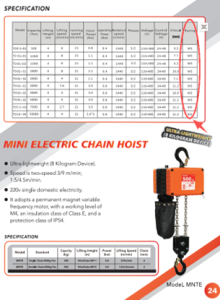
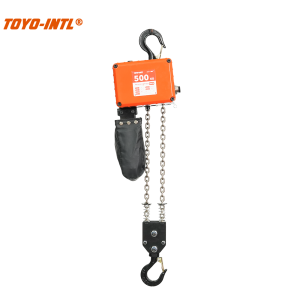
The MNTE Electric Chain Hoist page states working level M4, protection class IP54, and insulation class E. It lists 300 kg and 500 kg configurations, 220 V power, and two-speed examples of 3/9 m/min and 1.5/4.5 m/min.
The TD Electric Hoist page states work class M5, protection class IP55, and insulation class F. Its table publishes multiple capacity configurations with a 4 m lift and lifting-speed examples from 2.7 to 8 m/min.
These two product pages illustrate that electric chain hoists within one manufacturer’s range can publish different work levels, protection classes, capacities, and speed arrangements. They do not establish that one model is automatically suitable for a buyer’s application. Final selection still requires the actual operating profile.
Wire Rope Hoist Examples: SH, CD1, and DWH
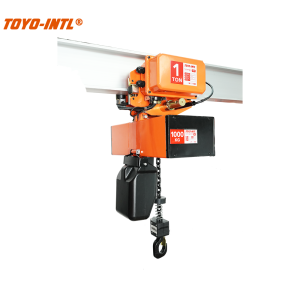
The SH Electric Hoist table publishes M4/30% ED for its displayed configurations. The table covers capacities from 1 to 10 t and includes lifting height, lifting speed, trolley speed, rope data, motor data, power supply, and package weights.
The CD1 Electric Hoist table labels its displayed configurations M3. It includes capacities from 0.5 to 10 t, several hoisting heights, single- and dual-speed notation, and IP44/IP54 protection information.
The DWH table uses paired FEM/ISO work-group labels. Different rows publish different groups depending on capacity and speed. This makes DWH a useful example of why the duty field must remain attached to the exact configuration rather than being summarized as one value for the entire family.
Check Unclear Source Notation Before Interpreting It
The PA Electric Hoist table currently prints its source duty note as S320%10min. That text should be confirmed before an article, quotation, or data sheet inserts spaces or explains its meaning. An editor may suspect an intended formatting, but a technical interpretation should come from the approved product documentation.
The same rule applies whenever a table contains merged labels, unusual abbreviations, or values that differ between a product description and a specification table. Preserve the source text, request clarification, and update the published explanation only after the responsible product team confirms it.
Operating Information Buyers Should Provide
A useful duty review starts with a clear operating profile. Include the following information in the inquiry:
- Maximum load
- Typical load
- Number of lifts or starts per hour
- Operating minutes per hour
- Operating hours per day
- Average vertical travel per cycle
- Required lifting speed
- Required low-speed positioning
- Required trolley-travel distance and speed
- Available voltage, phase, and frequency
- Indoor or outdoor installation
- Dust, water, humidity, temperature, corrosion, or other environmental conditions
- Planned inspection and service arrangements
If the operating pattern changes by shift or season, describe both the typical condition and the highest expected demand.
How to Read an Electric Hoist Duty Label
Identify the Exact Configuration
Start with the model code and specification row. Record the capacity, lifting height, lifting speed, trolley configuration, motor information, and power supply.
Preserve the Published Notation
Copy M3, M4, M5, M4/30% ED, or the paired FEM/ISO label exactly. Do not rewrite it into another classification system without an approved reference.
Confirm the Governing Documentation
Ask which manual, data sheet, or classification standard supports the label and whether it applies to the selected configuration.
Match the Label to the Operating Profile
Submit the expected loads, starts, operating time, lift distance, speed, and environmental conditions for technical review.
Record the Confirmed Class in the Quotation
The final quotation and technical documents should identify the confirmed model, configuration, work class, electrical supply, and any operating limitations.
Common Duty-Cycle Selection Mistakes
One common mistake is selecting by rated capacity alone. Another is assuming that every model in one product family shares the same work class. Buyers should also avoid mixing classification systems, ignoring starts and operating time, or copying a label without identifying the exact specification row.
Missing information should not be treated as a low rating or a product defect. If a page does not publish the field needed for selection, request the relevant manual, data sheet, or confirmation from the supplier.
Frequently Asked Questions
Is M5 always better than M4?
“Better” is not the right selection rule. The required class depends on the operating profile, product configuration, and classification system. A higher-looking label should not replace a review of the actual application.
Can two electric hoists with the same capacity have different duty information?
Yes. TOYO-INTL’s DWH table shows different work-group labels across capacity and speed configurations. The exact row must be reviewed.
What information is needed to confirm duty?
Provide maximum and typical load, starts or lifts per hour, operating minutes and hours, lift height, speed, trolley requirements, power supply, and environmental conditions.
Can M4 be compared directly with M4/30% ED or 1Am/M4?
The website alone does not provide a conversion method. Confirm the applicable classification system and supporting product documentation before making a direct comparison.
Conclusion
Electric-hoist duty information belongs to the exact model and configuration. TOYO-INTL product pages currently publish several different labels across MNTE, TD, SH, CD1, DWH, and PA. Those labels should be preserved, checked, and matched to a complete operating profile.
Before ordering, describe how the hoist will actually be used and ask TOYO-INTL to confirm the work class, model, electrical supply, configuration, and operating limitations in the technical documents and quotation.
| Step | Phase | Action | Key Details | Common Mistakes to Avoid | Output / Deliverable |
| 1 | Identify (Model) |
Locate the exact product series and model code on the supplier’s page or data sheet. | • Confirm product family (e.g., CD1, SH, DWH, MNTE, TD, PA) • Record the model code exactly as printed • Do NOT assume models are interchangeable |
• Assuming all hoists in one brand share the same work class • Skipping the model code and only noting the brand name • Confusing product series names (e.g., MNTE vs. TD) |
Confirmed product series (e.g., “DWH Double Girder Electric Hoist”) |
| 2 | Lock Configuration |
Identify the exact specification row (Row) that matches the required capacity, lift height, and speed. | • Record rated capacity (t) • Record lift height (m) • Record lifting speed (m/min) • Record trolley speed and travel distance • Record motor data and power supply requirements |
• Selecting by capacity alone (ignoring speed and lift height) • Changing one parameter and assuming the work class stays the same • Not noting the exact row number from the specification table |
Exact specification row with all parameters recorded |
| 3 | Copy Notation |
Copy the duty notation exactly as it appears — M3, M4, M5, M4/30% ED, or paired FEM/ISO labels. | • Do NOT simplify M4/30% ED to M4 • Do NOT remove one side of a paired FEM/ISO label • Do NOT convert one classification system to another without approved source • Connect the notation to the exact product and specification row |
• Silently simplifying “M4/30% ED” to “M4” • Dropping the FEM part from “1Am/M4” • Converting ISO to FEM (or vice versa) without official reference |
Exact duty notation bound to specific configuration |
| 4 | Provide Operating Data |
Submit a complete operating profile to the supplier for technical review. | • Maximum load & typical load • Starts/lifts per hour • Operating minutes & hours per day • Lift height, speeds, trolley travel • Power supply (voltage, phase, frequency) • Environment (indoor/outdoor, dust, water, temp, corrosion) • Planned inspection & service arrangements |
• Providing only rated capacity and nothing else • Hiding high-frequency usage or harsh environment • Forgetting to mention shift patterns or seasonal variations • Omitting environmental conditions |
Complete operating profile submitted to supplier |
| 5 | Technical Review |
Supplier reviews whether the proposed configuration matches the submitted operating profile. | • Verify work class (M3/M4/M5/etc.) matches duty requirements • Confirm electrical supply compatibility • Check protection class (IP rating) for environment • Validate insulation class for operating conditions • Assess if duty cycle (ED%) is adequate |
• Accepting supplier’s word without written confirmation • Skipping the technical review step • Assuming “higher M number = always better” without review |
Technical review result (Pass or Return) |
| 6 | Verify & Confirm |
Obtain written confirmation of the confirmed model, configuration, work class, and operating limitations in the quotation and technical documents. | • Request final RFQ/quotation with all confirmed parameters • Verify work class is explicitly stated • Confirm electrical supply and protection class • Document any operating limitations • Archive for future reference |
• Accepting verbal promises without written documentation • Not archiving the confirmed quotation • Failing to record operating limitations |
Written confirmation in quotation & technical docs |
Electric Hoist Selection Decision(Flowchart)